Best Bars In San Sebastian
The best bars in San Sebastián are not cocktail lounges with a view, they are the pintxo bars of the Parte Vieja and the surrounding neighbourhoods, where the drinking and the eating happen in the same place and the city's whole social life runs on txakoli, cider and small plates.
Short answer
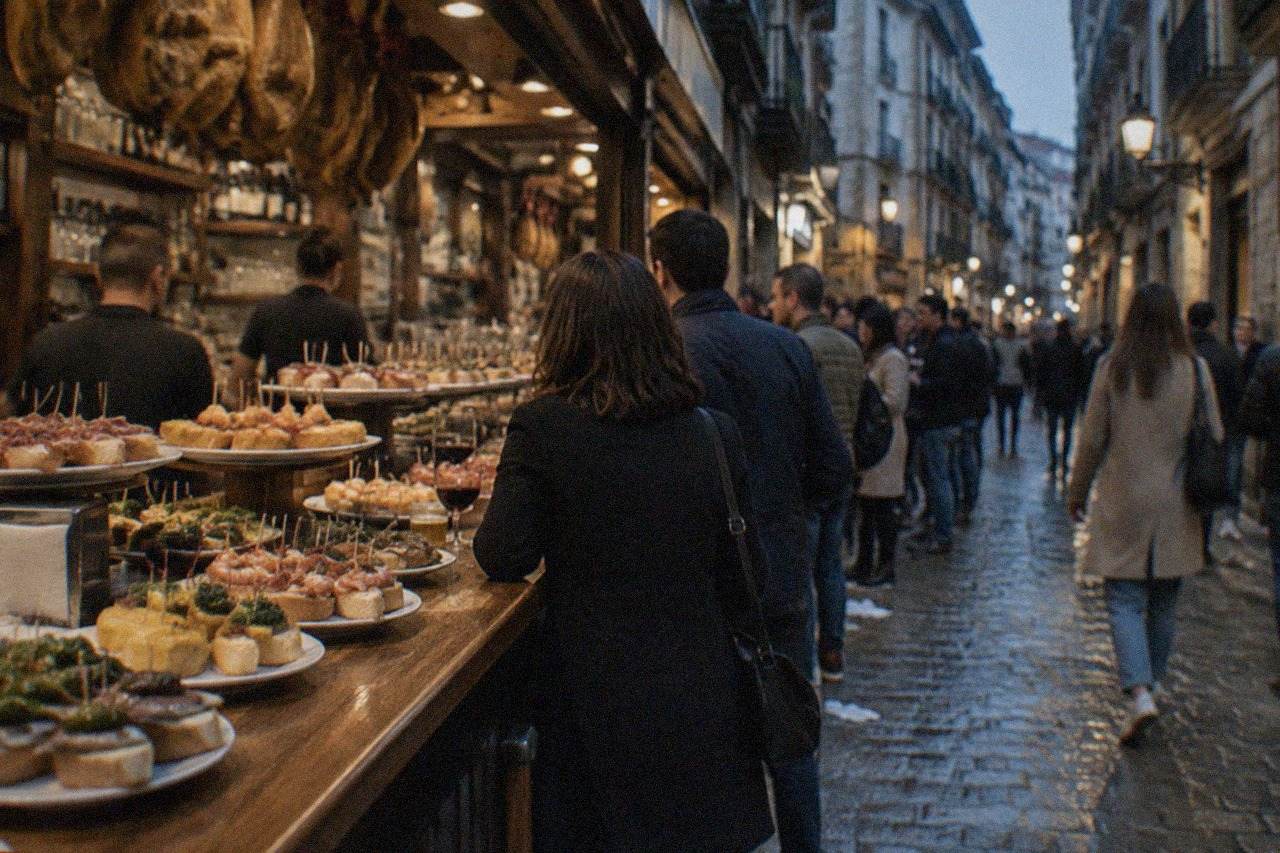
The best bars in San Sebastián are concentrated in the Parte Vieja (Old Town), especially the streets around 31 de Agosto and the port side, with a second cluster in the Centro and a more local scene in Gros and Antiguo. Expect standing room only, pintxos laid out on the counter, txakoli poured from a height, and a custom of hopping between several bars in one evening rather than settling in one.
San Sebastián, in the Basque Country of northern Spain, is a city whose official name is Donostia / San Sebastián and whose drinking culture is unlike almost anywhere else in the country. There is no big pub street and no cocktail district. Instead, the city runs on pintxo bars: small, counter-first rooms where the food is displayed on the bar itself, the drinks are mostly local, and the custom is to have one plate and one glass in each of four or five different bars in a single evening. The Basque name for this is a txikiteo, and it is the reason the question of the "best bars" here is really a question about which streets to walk.
The city's bar scene is anchored by the Parte Vieja, the Old Town between the port and the Urumea river, with the streets around 31 de Agosto at its heart. Around it sit the Romantic Area of the Centro, the Gros district across the river beside Zurriola beach, and the quieter Antiguo near Ondarreta. Each has a different character, and a good evening uses more than one of them. This guide covers how the bars actually work, what to order once you are standing at the counter, and where a guided tour fits in if you would rather have the choosing done for you. For the deeper background on the food itself, see what pintxos actually are and the companion page on the best pintxo bars.
How Do Pintxo Bars In San Sebastian Work?
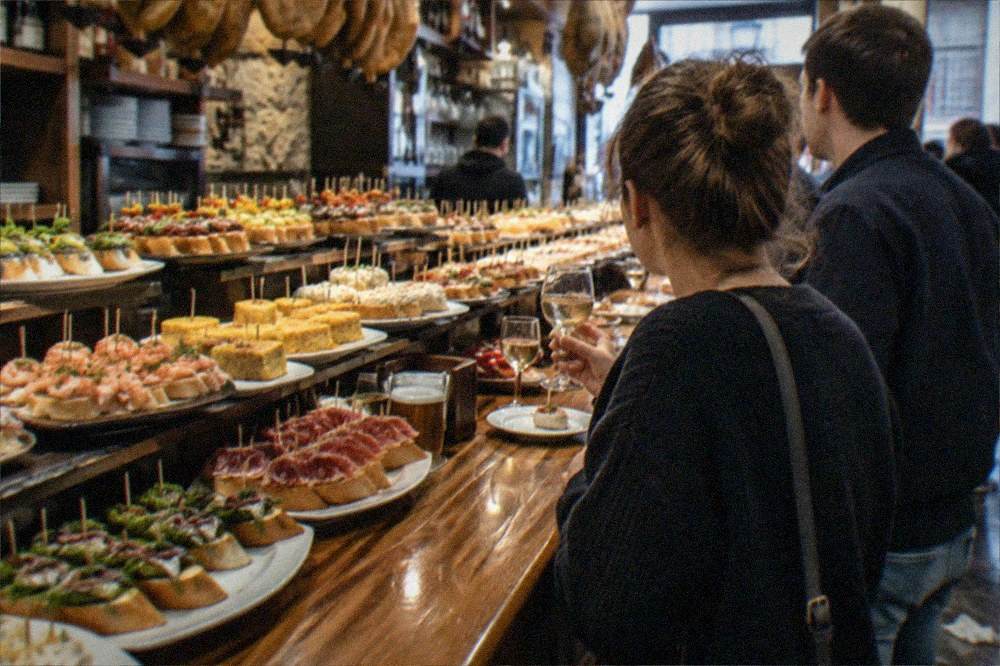
A pintxo bar in San Sebastián is a counter-first room where small plates are displayed on the bar, you point at what you want or take a plate from the display, you order your drink at the same time, and you pay when you finish, usually by telling the barman honestly how much you had. There is almost never table service, seats are scarce, and moving between several bars in one evening is the whole point rather than a sign the first bar was bad.
The system catches first-time visitors off guard in three ways. First, the food on the counter is not a display, it is the menu. Cold pintxos are laid out on trays on the bar top, and hot ones are made to order: you either point at a tray item or ask for the hot dish written on the chalkboard, called the carta. Second, there is no bill running up invisibly. In many bars the barman keeps a mental tally, or writes it in chalk on the counter in front of you, and you settle up as you leave. Third, nobody rushes you out, but nobody expects you to stay either. The rhythm is one or two pintxos and a drink, then the next bar.
The word itself matters. A pintxo, from the Basque verb "to pierce", is classically a slice of bread topped with something and skewered with a toothpick. Not everything on a modern counter is skewered, and plenty of bars now serve plate-sized raciones too, but the pintxo remains the unit of an evening out. The custom of eating standing, moving from bar to bar, is what locals call a txikiteo, and the small glass that goes with it, a txikito, is the traditional pour of txakoli or young red that fits the format.
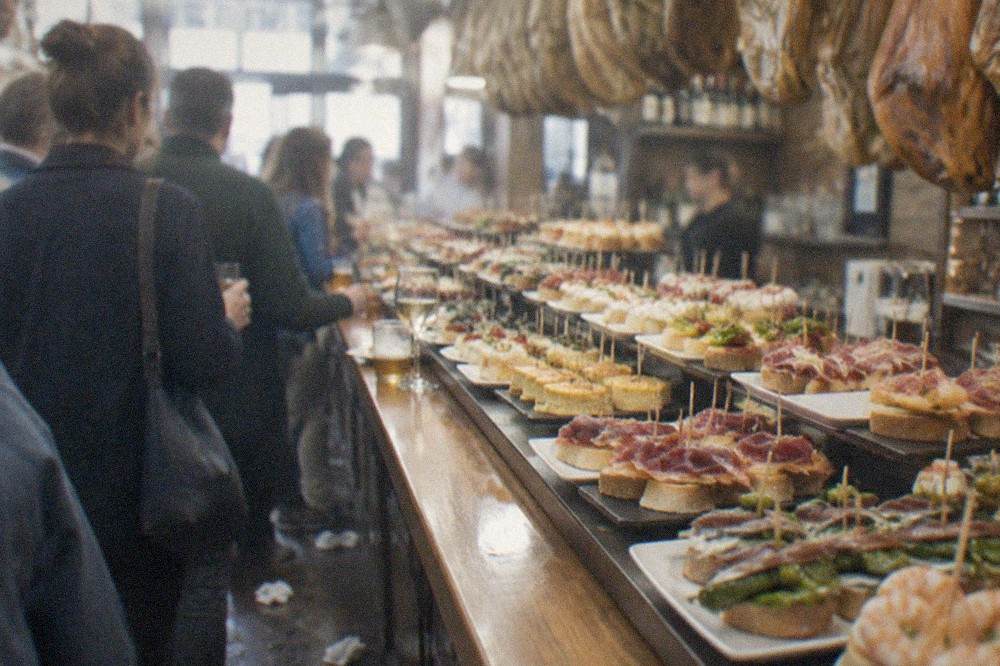
The table below summarises the mechanics, because the etiquette is simpler than the anxiety around it.
| Situation | What you do | What not to do |
|---|---|---|
| Arriving at the bar | Step up to the counter, greet the staff, look at the trays | Wait by the door to be seated |
| Choosing cold pintxos | Point at the tray or take a plate yourself if that is the custom | Handle every item on the tray |
| Choosing hot pintxos | Read the chalkboard carta and order it at the counter | Assume the display is the full menu |
| Ordering a drink | Order at the same time as the food, txakoli is the default pour | Ask for a full wine list for one pintxo |
| Paying | Tell the barman what you had, or let them tally it | Argue over the count, they are usually right |
| Moving on | Finish your glass, settle up, walk to the next bar | Camp at one counter all evening |
One habit worth adopting early: keep your used napkins and toothpicks on a napkin on the counter rather than the floor. The floor of a busy pintxo bar at midnight is already a problem without your contribution, and some bars keep a toothpick count for billing, so the skewers are evidence of what you ate. If you want a fuller walk-through of the district where most of this happens, the guide to the Parte Vieja covers the Old Town street by street.
Which Neighbourhood Has The Best Bars In San Sebastian?
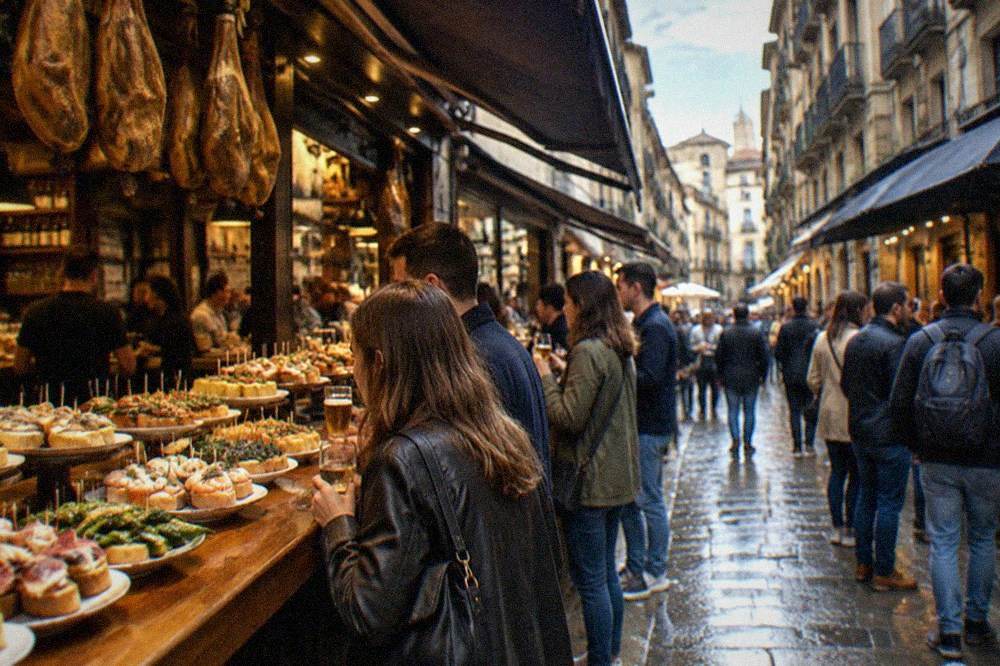
The Parte Vieja has the densest concentration of bars in San Sebastián, packed into the streets between the port, Plaza de la Constitución and 31 de Agosto, and it is where the classic bar-hop happens. Gros, across the river beside Zurriola beach, has a younger, more local scene with surfers and students, while the Centro has smarter wine-focused spots and Antiguo has neighbourhood bars where almost nobody is a visitor.
The Old Town is small enough that a full evening's crawl can cover five or six bars on foot without ever leaving the medieval street plan. The classic route runs along 31 de Agosto, the street named for the fire that destroyed the old town, and the parallel lanes down to the port, where grilled fish and seafood pintxos dominate because the boats used to land right there. Fermin Calbetón and the streets off the Boulevard hold many of the best-known names. It is loud, it is crowded, and on a Friday night it is closer to a street party than a pub crawl.
Gros is the other pole. Around the streets behind Zurriola beach, the bars are younger, cheaper in feel, and full of people who surf or study, and the pace is slower. The Centro, the Romantic Area of grid-plan streets built after the old town burned, holds the more polished wine bars and the hotel bars, including the grand ones inside the Hotel María Cristina and the Hotel de Londres. Antiguo, west of Ondarreta, is where the city drinks when nobody is watching.
| Neighbourhood | Character of the bars | Best for |
|---|---|---|
| Parte Vieja (Old Town) | Dense, loud, counter-first pintxo bars, seafood near the port | The classic txikiteo bar-hop |
| Centro (Romantic Area) | Smarter wine bars, hotel bars, cocktail rooms | A settled evening, wine-led drinking |
| Gros | Younger, local, surf-scene bars behind Zurriola | Late, informal, fewer visitors |
| Antiguo | Neighbourhood bars near Ondarreta | A quiet local drink |
| Egia and Amara | Student and residential bars, few visitors | Almost no tourist traffic |
If you are planning how long to give the city, the page on how many days to spend in San Sebastian suggests enough time to do the Old Town crawl properly rather than in one rushed evening.
What Should You Drink In A San Sebastian Bar?
The three drinks that define San Sebastián's bars are txakoli, the young, lightly sparkling white wine of the Basque coast, cider, both bottled and the draught sidra of the cider-house season, and zurito, the short local beer measure that fits the pintxo rhythm. Red Rioja and Ribera bottles appear on every serious counter too, because the Basque Country drinks far more Spanish red than it produces white.
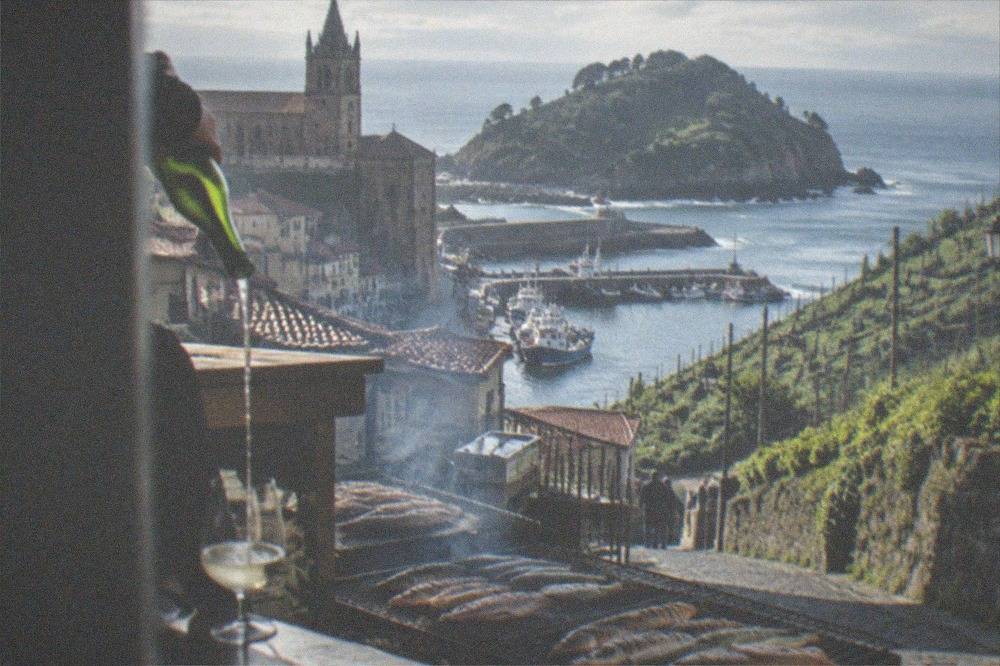
Txakoli is the one you should start with. It is a high-acidity white, traditionally poured from a height so it aerates and fizzes in the glass, and it exists to cut through anchovies, salt cod and oil. The main protected denomination is Getaria, the fishing town down the coast whose vineyards run to the sea, and the guide to txakoli covers how it is made and poured. Cider, sagardoa, is the other Basque drink with rules of its own: in a cider house it is poured straight from the barrel at the txotx, the moment the tap is opened, and the season for that ritual runs from the middle of January to the end of April by the tourism board's wording. In city bars cider arrives bottled, poured the same way, in one go.
The zurito deserves a word because visitors order it by accident and then love it. It is a short measure, roughly a small glass rather than a pint, designed so that it is still cold when you finish it and the group can move on. Ordering "una cerveza" will get you a full bottle in most bars, which slows the whole crawl down. The local spirit to know is patxaran, the sloe liqueur of Navarre, sweet, red and served as a digestif.
| Drink | What it is | How it is served |
|---|---|---|
| Txakoli | Young, high-acidity white wine of the Basque coast, Getaria is the main denomination | Poured from a height into a small glass, drunk young |
| Sagardoa (cider) | Basque apple cider, flat and dry | In a cider house straight from the barrel at the txotx, in bars from the bottle, poured in one go |
| Zurito | Short local beer measure, about a small glass | On tap, meant to be finished quickly |
| Patxaran | Sloe liqueur from Navarre, sweet and reddish | Small glass, after the meal |
| Rioja and Ribera reds | Spanish reds, heavily drunk in the Basque Country | By the glass or bottle on most counters |
The cider-house version of drinking is a different animal from the city bar. Out in Astigarraga, the cider capital just outside the city, the txotx season means standing in a cellar with the barrel open, catching your pour as it falls, and eating the fixed cider-house menu of salt cod omelette, fried cod and an enormous txuleta steak with cheese and walnuts to finish. The tourism board places the season from mid-January to the end of April, and the page on cider houses covers the ritual in detail.
Should You Take A Guided Pintxo Tour Of The Bars?
A guided pintxo tour is worth it on your first evening in San Sebastián, because the guide chooses the bars, secures counter space in rooms where there is none, orders for the group in a mix of Basque and Spanish, and explains each dish as it arrives, which removes every awkward step of the pintxo bar learning curve. On a later evening you can then bar-hop alone with the customs already understood.
The honest case against is simple: the bars are public, the system is learnable in one night, and a solo crawl is free apart from what you consume. The case for is that the first night is exactly when the system is most confusing, when you do not know which counter items are cold and which are made to order, and when you will otherwise default to the three bars with English menus and the biggest crowds. A good guide also buys access: a reserved stretch of counter in a bar that otherwise has none is worth more than any discount. Other pages covering the same trip are gathered on San Sebastian Spain Guide.
The flagship option on this site is the culinary pintxo tour capped at eight guests and led by an expert guide, which is deliberately small enough that every bar on the route can absorb the group. You can read the full details and check dates on the tour's own page, or see how it compares with the city's other food walks on the pintxos and food tours overview. If your evening is more about learning to cook than learning to order, a hands-on Basque class with wine and cider tasting covers the same culture from the kitchen side.
What Are The Classic Pintxos To Order At The Bar?
The pintxos that define San Sebastián's bars are the gilda, the anchovy-olive-pepper skewer, and the counter staples built on salt cod, Idiazabal cheese and Basque txitxiki, plus the hot dishes that appear on chalkboards: txalupa, brochettes, and the grilled txuleta when the bar becomes a restaurant. Around them sit the seafood pintxos of the port-side bars and the sweet finish of a La Viña cheesecake slice.
The gilda is the entry point and the test of any bar. It is three ingredients on a skewer, anchovy, guindilla pepper and an olive, salty, sour and sharp at once, and every bar in the city makes one, which makes it the fastest way to compare counters. The name, as the guide to the gilda pintxo explains, is credited to a film society that named it after a character in the film Gilda. Salt cod, bacalao, appears everywhere in pil-pil form, the emulsion of garlic, oil and the fish's own gelatin, and Idiazabal, the smoked Basque sheep's cheese, shows up melted over bread or in croquettes.
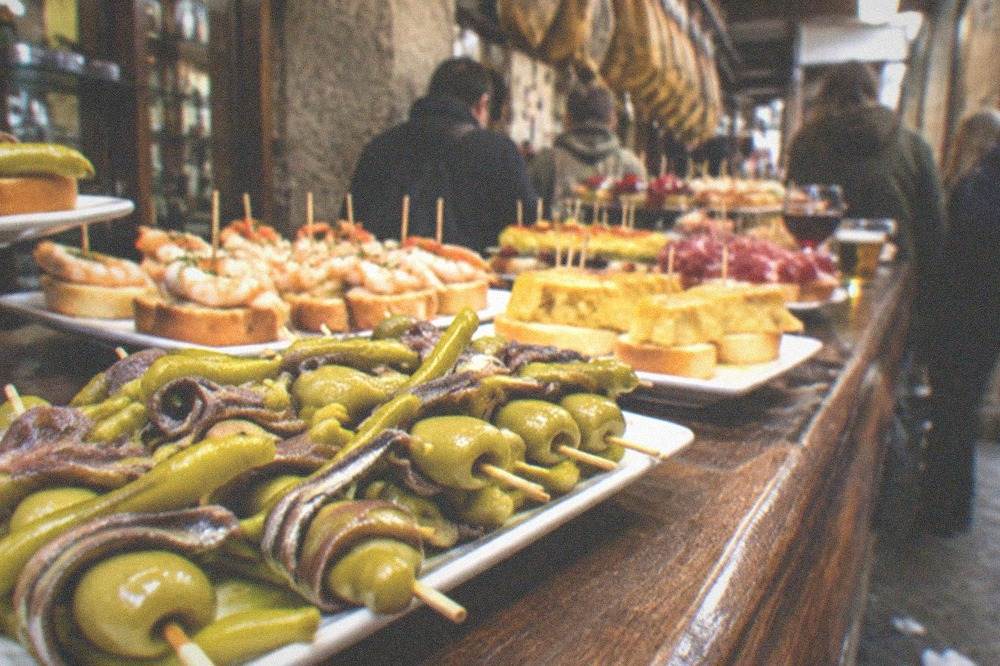
The hot chalkboard dishes are where the better bars separate themselves. Txalupa, a boat-shaped pastry shell with seafood bechamel, brocheta de gamba, a skewered prawn on bread, and the seasonal items, spider crab in its shell in winter, thistle stalks, mushrooms in autumn, are ordered by name rather than picked from the tray. For the full landscape of what to eat, the guide to what to eat in San Sebastian and the deeper history on pintxos in the city cover far more ground than any single bar crawl will.
| Pintxo | What it is | How you get it |
|---|---|---|
| Gilda | Anchovy, guindilla pepper and olive on a skewer, named after the film character | From the counter tray |
| Bacalao pil-pil | Salt cod with a garlic-and-oil emulsion made from the fish's gelatin | Ordered hot from the carta |
| Txalupa | Boat-shaped pastry with seafood bechamel | Ordered hot from the carta |
| Idiazabal croquettes | Croquettes of smoked Basque sheep's cheese | From the tray or ordered hot |
| Brocheta de gamba | Skewered prawn on bread, a hot classic | Ordered hot |
| Quesada (La Viña style) | Burnt Basque cheesecake | Ordered as a slice to finish |
The cheesecake deserves its own sentence because it has become the city's most exported dish: the burnt-top, unset-centre creation of La Viña in the Antiguo, now copied worldwide, and covered in full on the pages about La Viña cheesecake and San Sebastian cheesecake. Ending a bar crawl with a slice of it, in the neighbourhood where it was invented, is a reasonable final stop.
When Is The Best Time Of Year For A Bar Crawl In San Sebastian?
The best months for bar-hopping in San Sebastián are May, June and September, when the weather is warm enough that the bars spill onto the street, the visitor numbers are below the August peak, and the rain is near its annual low, though even July, the driest month, averages 86 mm, so no month here is reliably dry and the bars are the city's built-in rainy-day answer.
This is an Atlantic city and the climate data says so plainly. AEMET's normals for its Igeldo station, on the hill 250 metres above the seafront, record 1,507 mm of rain a year across 141 rain days, and the wettest month, November, averages 169 mm. The summer months are the driest, but even July, the driest of all, averages 86 mm over about ten rain days, which is why every local plan has an indoor version. The advantage of a pintxo bar evening over almost any other night out is precisely this: the whole activity is indoors, packed into small rooms, and a downpour changes nothing except the queue for the covered part of the street.
| Month | Mean temperature C | Rain mm | Rain days 1 mm+ | Bar-crawl character |
|---|---|---|---|---|
| May | 14.4 | 120 | 12.2 | Warm evenings, thinner crowds |
| June | 16.9 | 90 | 10.6 | Peak pintxo season, beach and bars |
| July | 18.9 | 86 | 9.8 | Driest month, busiest streets |
| August | 19.5 | 117 | 10.5 | Semana Grande, city at maximum |
| September | 18.0 | 111 | 10.1 | Regattas, film festival, locals return |
| November | 11.3 | 169 | 13.0 | Wettest month, bars at their most local |
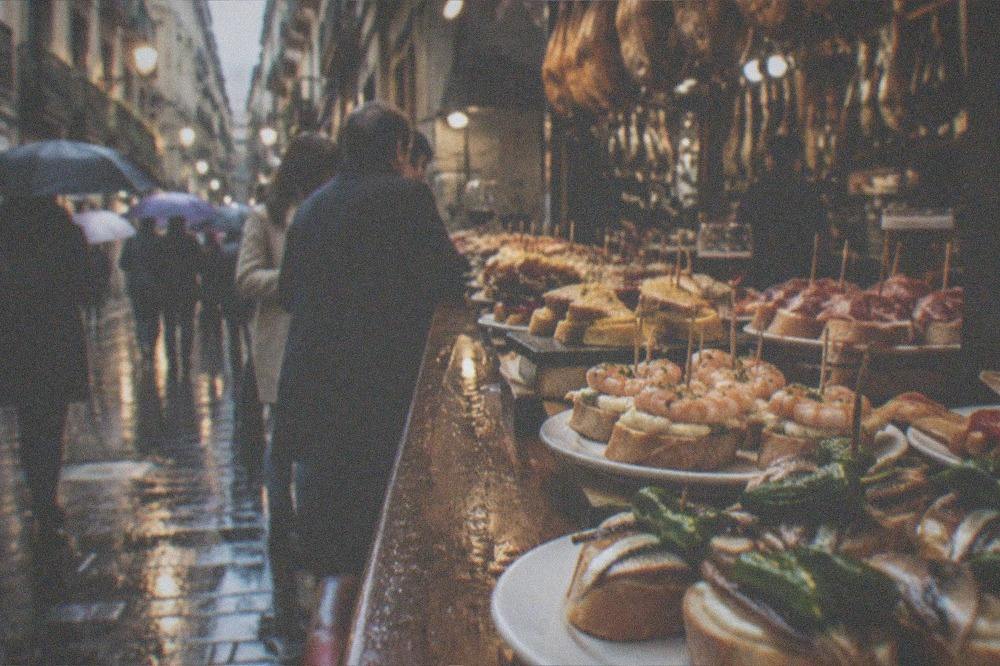
August deserves a warning even though it is warm. Semana Grande, the city's big festival, always falls in the week of 15 August, Saturday to Saturday, and it brings the fireworks competition, concerts and a city at its absolute fullest, which means the best bars have queues by nine in the evening. September has the La Concha regattas on the first two Sundays and the film festival, both of which fill the Old Town without the same crush. The month-by-month detail is on the best time to visit and in the San Sebastián weather guide.
How Does A Bar Evening In San Sebastian Actually Run?
A bar evening in San Sebastián starts late, with locals rarely settling into the first counter before nine, runs through four or five bars at a pace of one or two pintxos each, and often ends after midnight, which is why the city's bars are built for standing and short visits rather than long sittings. The whole evening is a walk, not a reservation.
The late timetable is the single biggest adjustment for visitors from dinner-at-seven countries. The pintxo crawl is the dinner, it starts when other cities are finishing theirs, and the streets around 31 de Agosto are at their fullest between ten and midnight. A practical structure that works: begin at the port-side end with seafood, work inland through the classic counters, save a chalkboard hot dish for the third or fourth bar when the appetite is real, and finish either with a patxaran or with a slice of cheesecake if the route has drifted toward the Antiguo. Four to six bars is a normal evening, two pintxos each is a normal appetite.
Money and payment are simpler than they look. Bars take cards in the Old Town as a rule, cash is still handy for the smallest counters, and the honest-tally system means you keep rough track of your own count. Nobody tips per round in Spain, and a crawl is not the place to start. For what a night out and a few days in the city cost overall, see is San Sebastián expensive.
The other evening format worth knowing is the cider-house dinner, which inverts everything: instead of moving between bars you stay in one cellar for the whole night, and instead of small plates you eat the fixed sequence of cod omelette, fried cod, txuleta and cheese with walnuts, with the barrel open behind you. The farmhouse and cider-house visit with the meal included is the tour version of that evening, and the cooking class with wine and cider tasting is its kitchen-side cousin. For those who would rather stay in the city and let a local lead the way from counter to counter, the pintxo tasting walk with paired wines is the classic version of the evening, and the full selection of the site's food and cider experiences is gathered below.
Whichever of those formats suits your evening, the practical advice is the same: book the guided version for the first night if the pintxo system is new to you, then repeat the route on your own once you know how a counter works. The three options below cover the full spread, from the small-group crawl through the Old Town to the cooking class and the cider-house meal.
Do The Bars Close For Winter Or Festivals?
The pintxo bars of San Sebastián run all year, and winter is when they are at their most local, but the calendar reshapes them twice: the txotx cider-house season runs from mid-January to the end of April and pulls the drinking crowd out to Astigarraga, and the festival weeks, Tamborrada on 20 January, Semana Grande in August and the film festival in September, fill the same bars to bursting.
Tamborrada, the drum festival of 20 January, is the city's own festival and the Old Town bars are its headquarters, with companies of drummers in 19th-century dress marching between them from the morning onward. Santo Tomás on 21 December is the other winter landmark, a country fair whose traditional food is txistorra sausage in bread, and the bars do a roaring trade in it. Neither changes which bars are good, they change how full they are and how early.
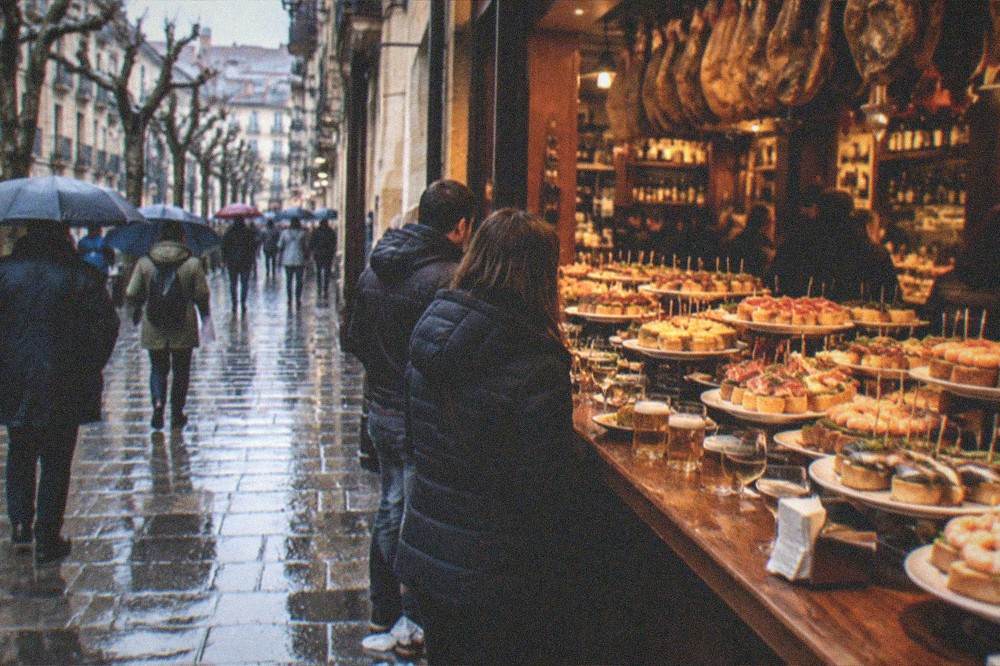
The cider-house calendar is the one true seasonal rule in the drinking year. The txotx season, from the middle of January to the end of April in the tourism board's wording, is when the barrels are open and the cellars serve the full menu, and the city's bars visibly empty on winter weekends because half of Gipuzkoa is in a cider house. The cider houses guide covers how to book one. For the festival calendar in full, see San Sebastián's festivals.
Common Questions About San Sebastian Bars
What Is The Best Area For Bars In San Sebastian?
The Parte Vieja, the Old Town, has the densest concentration of pintxo bars in San Sebastián, especially the streets around 31 de Agosto and the port side. Gros is the younger alternative and the Centro the smarter one, but the classic bar-hop is an Old Town walk.
What Do You Drink In San Sebastian Bars?
Txakoli, the young sparkling white of the Basque coast, is the default pour, alongside cider, the short beer measure called a zurito, Spanish reds by the glass, and patxaran as a digestif.
Do You Need To Book Pintxo Bars In San Sebastian?
Almost never. Pintxo bars work on a standing, walk-in basis, and the custom is to move between several in an evening. The exceptions are the small-group food tours that reserve counter space, and the cider houses in season, which serve a fixed menu and need booking.
How Many Bars Should You Visit In One Evening?
Four to six bars is a normal txikiteo, with one or two pintxos and a small drink in each. The evening is a walk, not a sitting, and the bars are designed for short visits.
What Is A Gilda Pintxo?
The gilda is a skewer of anchovy, guindilla pepper and olive, and it is the classic counter test of any bar in the city.
Are San Sebastian Bars Open In Winter?
Yes, the pintxo bars run all year and winter is when they are at their most local. The main seasonal shift is the txotx cider-house season from mid-January to the end of April, which draws crowds out to the cider cellars of Astigarraga.
The best bar in San Sebastián is, in the end, the next one on the route, and the city's whole design rewards the walker: start at the port, work the counter trays, pour the txakoli high, and let the evening decide how many stops it needs.