Monte Urgull And Castillo De La Mota
Monte Urgull is the green headland that separates La Concha from the old town of San Sebastián, Basque Country, Spain, and its summit fortress, the Castillo de la Mota, has watched over the city since the twelfth century.
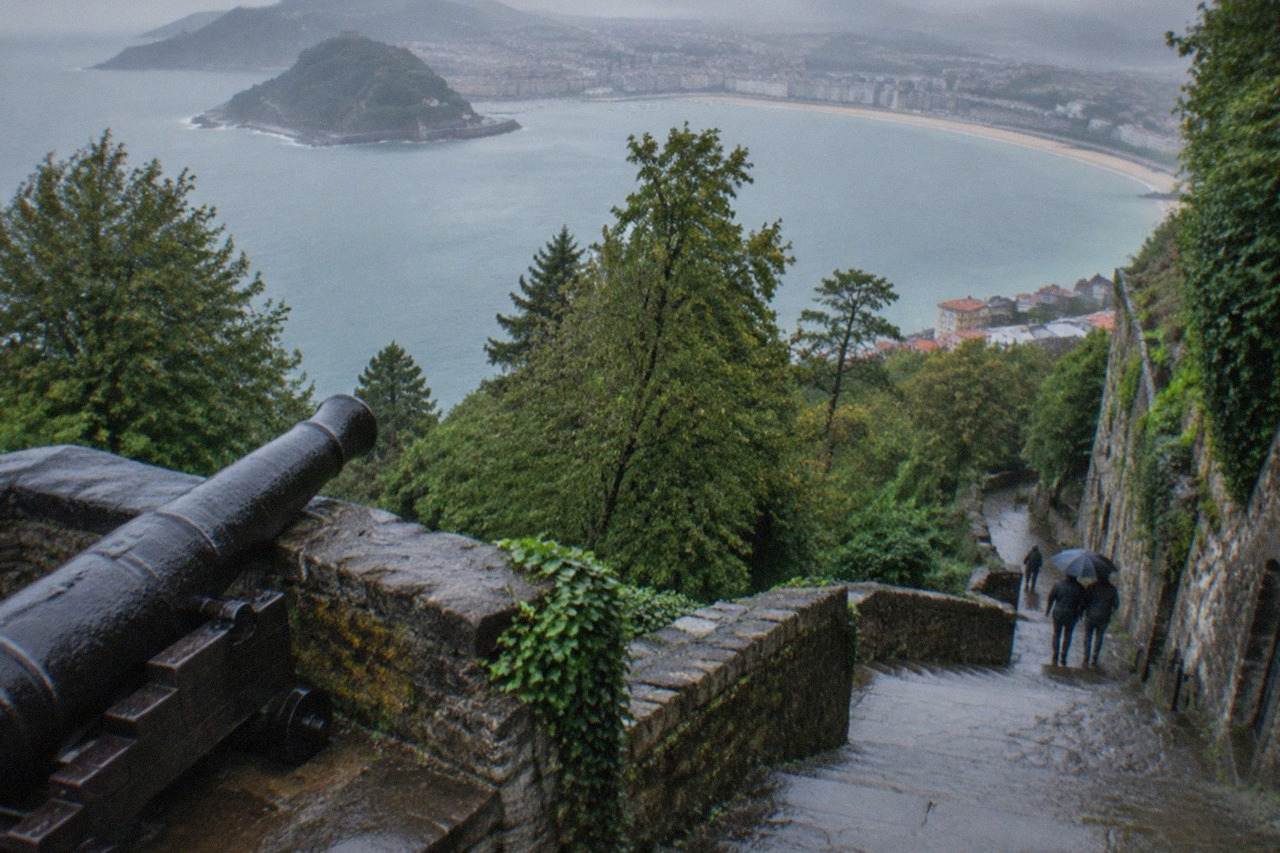
Short answer
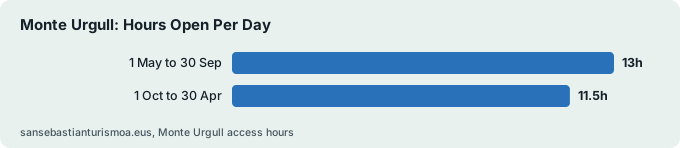
Monte Urgull is free to enter and open 08:00 to 21:00 from 1 May to 30 September and 08:00 to 19:30 from 1 October to 30 April. The Castillo de la Mota on its summit holds the Casa de la Historia de Urgull, a small museum run by San Telmo Museoa.
Monte Urgull is the tree-covered headland that rises between La Concha beach and the Parte Vieja, the old town of San Sebastián, Basque Country, Spain, the city whose official name is Donostia / San Sebastián and whose Basque name, Donostia, is used on every street sign alongside the Spanish one. The hill is the reason the old town sits where it sits: the settlement that became the city grew in the shelter of this promontory, and the fortress on top of it, the Castillo de la Mota, defended that settlement for centuries. Today the mount is a free public park, criss-crossed by paths, dotted with monuments and cannons, and capped by a castle that now holds a small history museum. For many it is the best free viewpoint in the city, and the tourism board lists it among the city's hills alongside Monte Igueldo across the bay.
What Is Monte Urgull And Why Does It Dominate San Sebastian?
Monte Urgull is a wooded hill at the eastern end of La Concha bay in San Sebastián, Basque Country, Spain, standing between the Parte Vieja old town and the sea, with the Castillo de la Mota fortress on its summit. It is a free public park, open every day of the year, and its paths link the Parte Vieja, the port and the Paseo Nuevo seafront in a single walk. The castle on top crowns the hill and the settlement below grew in its shadow.
The geography is simple once you stand on the seafront. La Concha curves away to the west, Monte Igueldo closes the bay at its far end, and Urgull is the green wall at the near end, directly behind the old town. On the other side of the hill, facing east, the Paseo Nuevo runs along the base where the waves break against the sea wall, and beyond it the River Urumea reaches the sea beside the Kursaal. A walker who goes up from the Parte Vieja side and down to the Paseo Nuevo side crosses the whole hill in one short loop and sees both faces of the city.
The hill has been a military position for most of its recorded life. The Castillo de la Mota was rebuilt and rearmed repeatedly over its long military life, and the batteries, powder stores and barracks still stand on the slopes. The English demolished parts of the fortifications after the siege and fire that destroyed the old town in the Peninsular War, and the city rebuilt them later in the century. The military handed the hill to the city, which turned it into the park visitors walk today.
The park is not wild woodland, it is a designed landscape. Dense trees, mostly mature specimens planted when the hill became a public park, shade the paths, and clearings hold monuments, old cannon emplacements and viewpoints. The city council and the tourism board both present Urgull as one of the city's three hills, with Igueldo to the west and Ulia to the east beyond the Kursaal, and the hill is the only one of the three you can walk to from the centre without crossing a river or boarding transport. Monte Ulia is the long eastern ridge, a different proposition altogether.
What Are The Opening Hours And Access Rules For Monte Urgull?
Monte Urgull is open to the public free of charge, with access hours that change by season: from 1 May to 30 September the hill is open 08:00 to 21:00, and from 1 October to 30 April it closes earlier, at 19:30. The gates close at night in both seasons, so the summit and the Castillo de la Mota cannot be visited after dark. There is no ticket, no booking and no charge to enter the park at any time of year.
Those hours come from the official tourism board page for the hill, and they matter more here than at most city parks because the summit is a genuine vantage point and visitors often plan a sunset visit. In the summer season the 21:00 closing gives enough daylight for an evening walk, since the sun sets late in June and July at this latitude on the Bay of Biscay coast. In the winter half of the year the 19:30 closing lands close to or after dark, so a winter visit is effectively a daytime plan.
The closing rule exists because the hill is unlit and the paths are steep in places, with steps and tree roots. The city treats the mount as a park with gates, not an open street, and the same rule applies year after year, so a visit planned around it will not be caught out by a seasonal surprise. What the pack does not give is a walking time or a height for the climb, and this page will not invent one: the answer page that covers the climb time in detail is how long it takes to climb Mount Urgull.
There are several ways up, and the main entrances are easy to find. From the Parte Vieja, paths start near the church of Santa María del Coro and from the port side beside the aquarium. From the Paseo Nuevo, a broad path climbs from near the sea wall. All of them meet near the summit, and none of them involves anything more difficult than a sloping path or a flight of steps. Visitors with limited mobility should treat the summit as a serious climb and check conditions on the ground, since the pack gives no accessibility detail for the paths themselves.
The table below sets out the season rules that shape any visit to the hill and the things around it.
| What | Season rule | Source of the rule |
|---|---|---|
| Monte Urgull access | 08:00 to 21:00, 1 May to 30 September | Tourism board page for the hill |
| Monte Urgull access | 08:00 to 19:30, 1 October to 30 April | Tourism board page for the hill |
| Entry charge | Free, no ticket | Tourism board page for the hill |
| Beach lifeguards, all three beaches | 1 June to 30 September | City council beach pages |
| Hondalea on Santa Clara island | 1 June to 30 September, 11:00 to 18:30 | Council Hondalea visit page |
| Santa Clara island boat high season | 1 June to 30 September | Operator tariff page |
The pattern is worth noticing: the whole bay runs on a summer season that peaks between June and September, and Urgull's own hours shift in May, a month earlier than the beaches and the boats. A May visitor gets the longer hill hours before the beach infrastructure is fully running, and an October visitor keeps the 21:00 closing only until the last day of September.
What Is The Castillo De La Mota And The Casa De La Historia De Urgull?
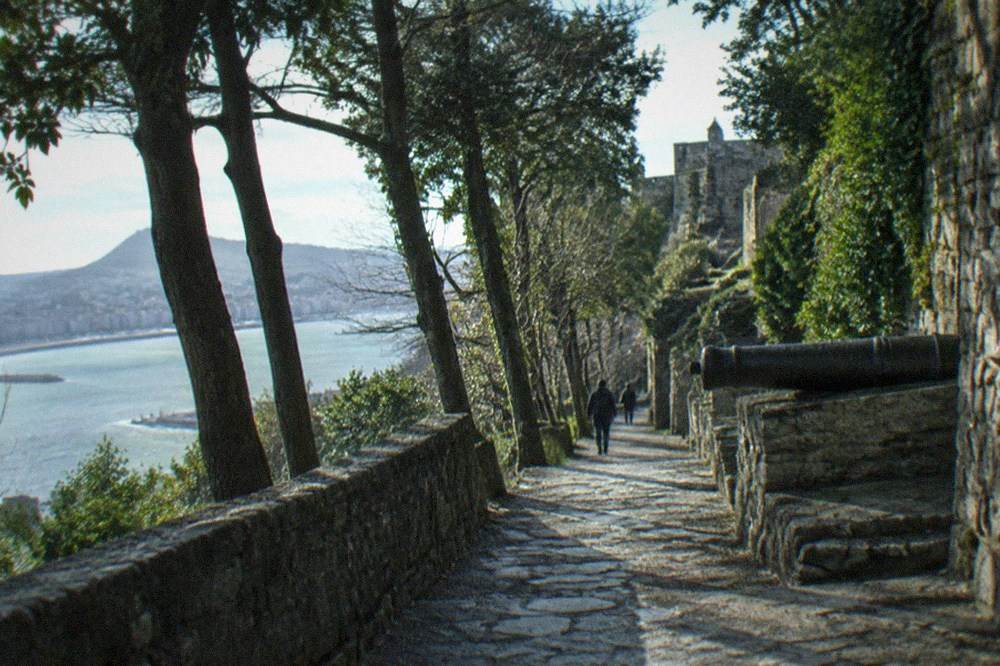
The Castillo de la Mota is the fortress on the summit of Monte Urgull, a military site rebuilt over centuries, and today it holds the Casa de la Historia de Urgull, a small museum about the city's history run by San Telmo Museoa. The castle's most visible feature is the large statue of the Sacred Heart of Jesus that rises above the ramparts, erected on the old fort's highest point. The museum is small, focused and free of the crowds of the seafront below.
The fortress and the city grew together. The first castle on the hill dates from the era when the king of Navarre founded the settlement at the foot of the mount, and the fortifications were expanded under the kings of Castile, who made San Sebastián a port town with walls. The hill's batteries fired in the sieges of the early years, including the siege of the Peninsular War that ended with the burning of the old town, an event the Casa de la Historia covers in its displays. After the military era ended, the hill passed to the city and the castle found a civic purpose.
The Casa de la Historia de Urgull is run by San Telmo Museoa, the city's main history museum at the foot of the hill, and it tells the story of San Sebastián from its founding through the sieges to the Belle Époque and beyond. The pack gives no hours or admission figure for the Casa de la Historia itself, so this page does not print any: check with San Telmo Museoa or at the site. The parent museum's own terms are on the record, and they give a sense of how the city runs its museums.
| Item | Figure | Note |
|---|---|---|
| San Telmo Museoa general admission | 10.00 EUR | The parent museum of the Casa de la Historia |
| San Telmo Museoa reduced ticket | 4.00 EUR | Students, over 65s, large families and others |
| San Telmo free day | Every Tuesday | Free for everyone |
| San Telmo free entry, any day | Under 25s | Among other groups |
| San Telmo opening days | Tuesday to Sunday | Closed Mondays, except holidays and long weekends |
| San Telmo summer hours | 10:00 to 20:00 | 1 April to 31 October |
| San Telmo winter hours | 10:00 to 19:00 | 1 November to 31 March |
The statue above the castle is the thing many visitors photograph first, and it answers a question people arrive with. Whether there is a statue of Jesus in San Sebastián, Spain, and what it is, has its own answer page on this site, and the short version is that the figure on Urgull is the Sacred Heart monument that replaced the fort's chapel cross. From the bay it reads as a dark silhouette against the sky, and from the ramparts it is simply the highest thing on the hill.
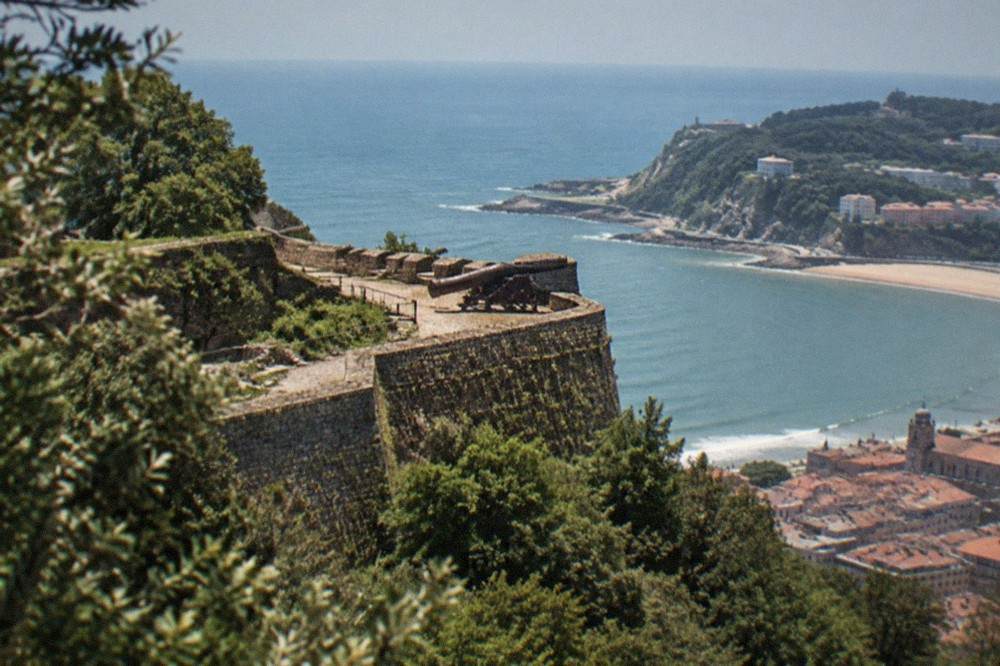
The ramparts themselves are the reward. From the top you look straight down La Concha to Monte Igueldo, across to Santa Clara island, along the coastline to the east, and over the rooftops of the Parte Vieja immediately below. The Kursaal's two cubes sit across the river mouth, and on regatta days in September the viewing angles over the water are the reason the hill fills up.
If the hill has sold you on the city, a guided walk is the natural next step, and the short city walk below is the one that fits an Urgull day best.
What Can You See From The Top Of Monte Urgull?
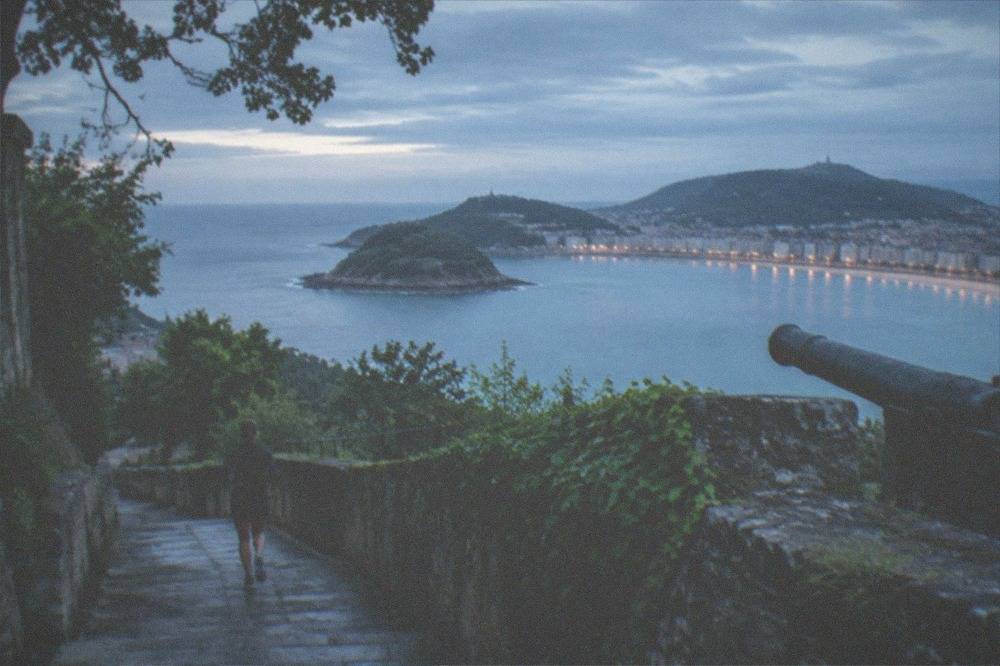
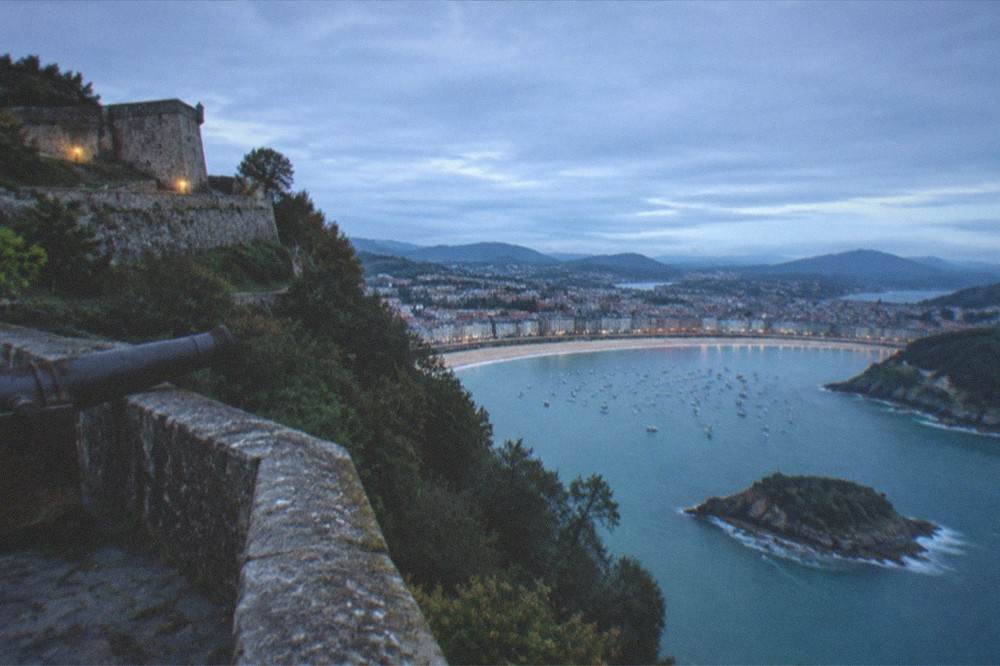
From the summit of Monte Urgull you can see the full curve of La Concha beach, Monte Igueldo and its funicular across the bay, Santa Clara island in the middle of the water, the Parte Vieja rooftops directly below, the River Urumea mouth and the Kursaal to the east, and the open Bay of Biscay beyond. It is the single viewpoint in San Sebastián that takes in the whole bay in one frame, and it costs nothing.
The view divides into four quadrants, and each one has a story. To the west and south lies La Concha itself, the 1,350 metre sandy crescent the council describes as shallow and tide-limited, with the promenade, the La Perla spa building on the sand and the two ends of the bay closing the picture. Across the water, Monte Igueldo's funicular climbs its slope, and the amusement park structures at the top mark the far end. In the middle sits Santa Clara island, whose lighthouse holds the Hondalea installation in summer.
To the north, the open sea. The Bay of Biscay runs out to the horizon, and the weather that comes off it is the city's defining fact: AEMET's normals for its Igeldo station on the hill opposite record 1,507 mm of rain a year over 141 rain days, and even July, the driest month, averages 86 mm. A visit to Urgull should carry the same assumption as any other plan in this city, that rain is possible on any day of the year, and the hill's trees make a shower easy to wait out.
To the east, the city's newer face. The River Urumea reaches the sea beside the hill, the Kursaal congress centre stands on the far bank, and the coastline runs out toward Monte Ulia, where the Camino de Santiago coastal route continues east. The Zurriola beach in Gros sits behind the Kursaal, the surfers' beach, and from the upper paths you can watch the swell the council page describes as strong.
Below, immediately under the north face, the Paseo Nuevo sea wall takes the waves, and the aquarium stands at its foot. The old town's three plazas, its church towers and the rooftops of the streets that burned in the Peninsular War and were rebuilt on the same grid are all readable from the ramparts. On the first two Sundays of September the La Concha regatta brings the trainers' boats onto the water below, an event first held in 1879, and the hill is one of the free places to watch it from.
| Direction from the summit | What you see | Featured on this site |
|---|---|---|
| West and south | La Concha beach and promenade, La Perla, Monte Igueldo and funicular | La Concha beach guide |
| Bay centre | Santa Clara island and its lighthouse | Santa Clara island guide |
| North | Open Bay of Biscay, Paseo Nuevo sea wall | Aquarium guide |
| East | River Urumea mouth, Kursaal, Zurriola, Monte Ulia | Kursaal and Zurriola guides |
| Below south face | Parte Vieja rooftops, port, Plaza de la Constitución | Parte Vieja and plaza guides |
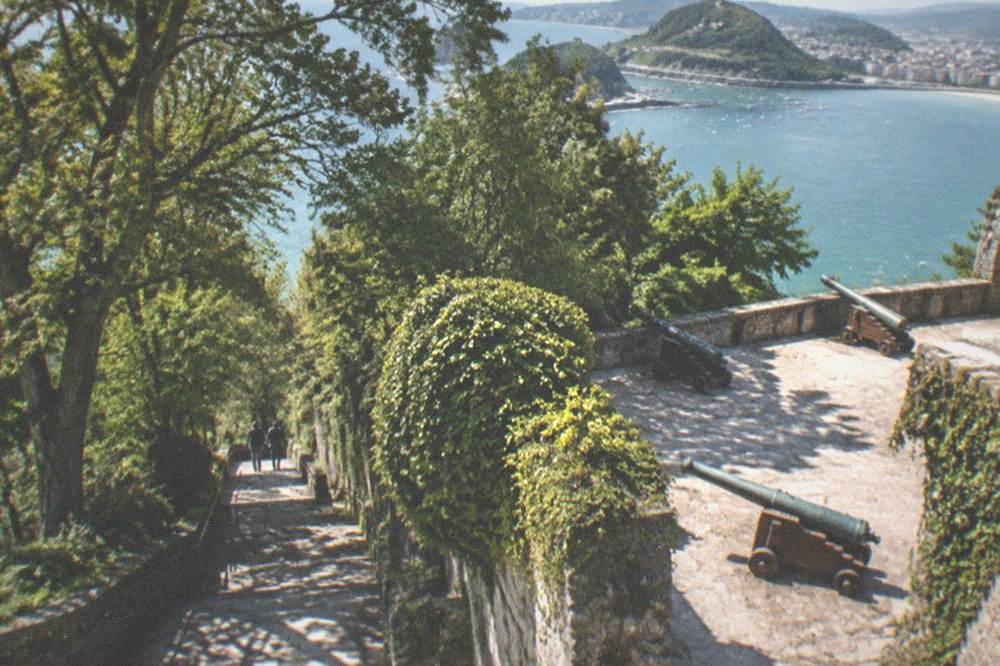
The hill also carries open-air sculpture and monuments on its slopes, part of the city's habit of putting art in the landscape that produced the Peine del Viento at the far end of the bay. The military remnants, batteries, cannon and powder stores, are left in place as exhibits, and the paths between them are the walk itself.
How Does Monte Urgull Fit Into A Day In San Sebastian?
Monte Urgull fits into a San Sebastián day as a one to two hour loop from the Parte Vieja, best placed either early morning, before the beaches fill, or late afternoon, when the summer closing hour of 21:00 still leaves time on the summit. Climb from the old town, visit the Castillo de la Mota and the Casa de la Historia, then come down to the Paseo Nuevo. The hill pairs naturally with the old town, the port and La Concha, all of which sit at its foot.
A practical loop looks like this. Start in the Parte Vieja, where the streets around the Plaza de la Constitución hold most of the old town's daily life, and take the path up from near the Santa María del Coro church or the port side. At the top, do the full circuit of the ramparts, since the view changes completely at each face. Come down the east side to the Paseo Nuevo, walk the sea wall to the aquarium, and you are back at the old town within a few minutes along the port. The whole circuit keeps you inside the two headlands that define the city centre. Other pages covering the same trip are gathered on San Sebastian Spain Guide.
The pairing that works least well is Urgull plus Igueldo in one push. The two hills are on opposite sides of the bay and serve different purposes: Urgull is the walk-up city hill, Igueldo is the funicular hill with the park at the top, and the funicular's own site sells no downhill-only ticket, so a plan that involves walking up one hill and riding down the other does not exist. Whether Monte Igueldo is worth the trip, and what the funicular is, each has its own answer page, and the Monte Igueldo attraction page covers the far hill in full.
For visitors with a full day, the hill slots between the morning and the evening. The old town's bars run all day, the beach season brings lifeguards from 1 June to 30 September, and the hill's shade makes it the obvious midday move in a city where summer means 21.8 degrees as a July mean maximum, warm but not southern-Spanish heat. The table below sketches how the pieces of a day around the hill fit together.
| Time of day | Plan around Monte Urgull | Why it works |
|---|---|---|
| Early morning | Climb before the beaches fill, then breakfast in the Parte Vieja | Cool paths, empty ramparts |
| Midday | Shade on the hill, Casa de la Historia, down to the port for lunch | Trees cover most of the climb |
| Late afternoon | Beach first, then up for the evening light before the 21:00 close | Summer closing leaves evening margin |
| September regatta Sundays | Summit or ramparts for the racing on the water below | First two Sundays of September, women 11:00, men 12:00 |
| Winter | Midday loop, down before the 19:30 close | Short daylight at this latitude |
Should You Visit Monte Urgull With A Guided Tour?
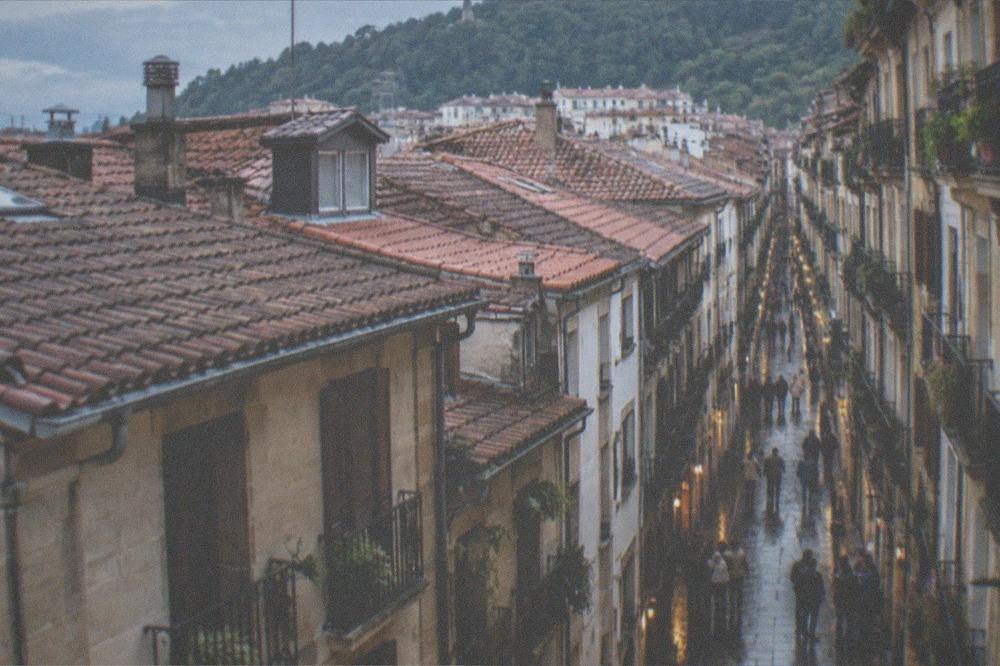
Monte Urgull itself needs no guide, the paths are obvious and the summit is unavoidable, but a guided walking tour of San Sebastián adds the history the hill cannot tell you itself. A short guided walk that ends with a pintxo and a drink included is the budget option, and food-led walks through the old town pair well with a self-guided climb afterwards. Book the walk, climb the hill on your own, and spend the saved hours in the bars.
The logic is about where the knowledge lives. The hill's story, sieges, fires, the fortress, the statue, is told in the Casa de la Historia and in the displays on the slopes, so the climb is self-explanatory. What a guide adds is the city around it: why the old town's grid looks the way it does, which bars matter, how the three hills relate. The tours below cover that ground.
The walking tour with a pintxo and drink included is the natural companion to an Urgull visit, since it starts from the city centre within sight of the hill and finishes in a bar, which is where a hill walk should finish anyway. The bike tour takes a different slice of the city, the flat end-to-end ride along the bay, and it passes the base of the hill on the seafront. The shared pintxo tour with drinks and tapas led by a local covers the old town streets that sit directly under the ramparts.
The order matters on a hot day or a rainy one. This is a wet Atlantic city: AEMET's Igeldo station records rain on 141 days a year, November averages 169 mm, and August, at 117 mm, is wetter than June, July or September. A tour with an indoor component, a bar, a kitchen, is the flexible half of the day, and the hill climb is the half you take when the sky allows. The site's rainy day guide handles the other outcome.
What Is The History Of Monte Urgull And The Fortress?
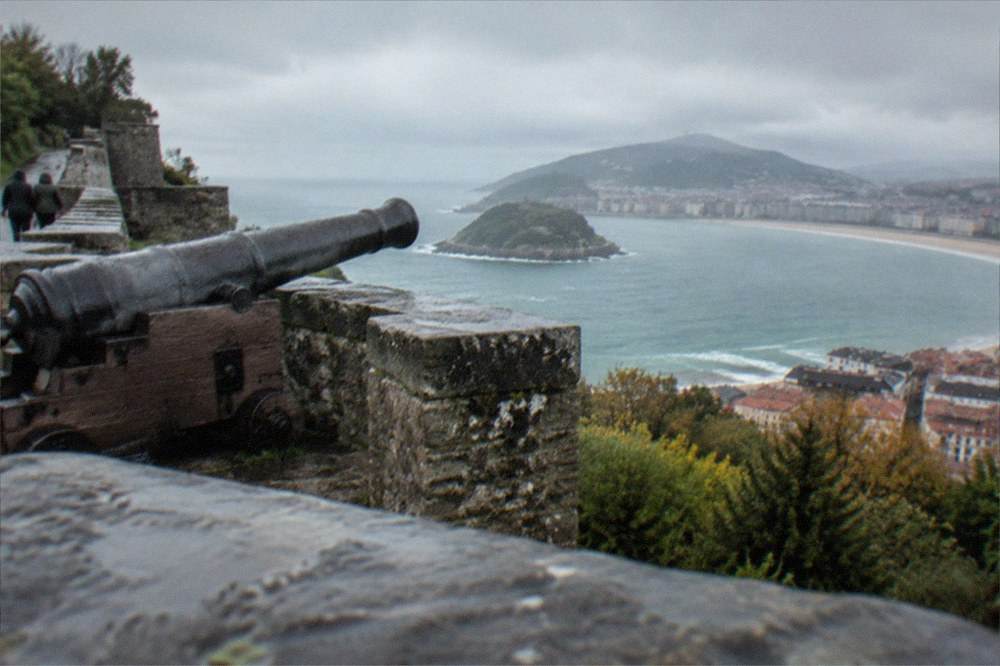
The history of Monte Urgull is the history of San Sebastián itself: a castle on the hill, a walled port town at its foot, sieges and destruction in the Napoleonic era including the fire that burned the old town, and a rebirth as a royal resort under Queen María Cristina, whose Miramar Palace was built in 1893. The fortress was rearmed and expanded across those centuries before the military finally left and the hill became a public park.
The founding moment belongs to Navarre. The town of San Sebastián was established at the foot of the mount, in the shelter of the castle above it, and the arrangement, fortress on the hill, port and walls below, defined the settlement for its first seven hundred years. Under Castilian rule the town became a military port and a fishing port, and the hill's batteries were the city's defence against the sea-borne attacks that came with that role, including raiders from the sea.
The events that the Casa de la Historia documents took place early in the city's history. The city was besieged in the Peninsular War, and the fighting ended with a fire that destroyed almost the entire old town, sparing a handful of streets. The town was rebuilt on the old grid, which is why the Parte Vieja's layout looks older than most of its buildings. The fortifications on the hill were demolished and rebuilt through the decades that followed, and the hill kept a military garrison.
Then the city changed trade. The Belle Époque arrived, the royal court summered here, and Miramar Palace was built in 1893 at the request of Queen María Cristina, designed by the English architect Selden Wornum, on the headland between La Concha and Ondarreta. The beach town that grew around that court needed a pleasure hill rather than a fortress, and the mount became the wooded park it is now, its batteries left as monuments. The statue of the Sacred Heart went up on the summit, and the Castillo de la Mota's interior later became the Casa de la Historia run by San Telmo.
The timeline below compresses that story into the stops a visitor can still find on the hill and around it.
| Period | Event | What you can see today |
|---|---|---|
| 12th century | Castle founded on the mount | Castle site and city founding story at the Casa de la Historia |
| 16th century | Walled port town | Old street grid of the Parte Vieja |
| Peninsular War era | Siege and fire destroy the old town | Rebuilt grid, the story in the Casa de la Historia |
| 19th century | Fortress rearmed, then military era ends | Batteries, cannon and powder stores on the slopes |
| 1893 | Miramar Palace built for the royal summer | Palace and gardens on the bay |
| 1950 | Sacred Heart statue erected | Statue, park paths, monuments |
| 2016 | City's European Capital of Culture year, shared with Wrocław | Contemporary city around the hill |
The city's World Heritage link runs through the water beside the hill rather than the hill itself: the coastal Camino de Santiago route, inscribed by UNESCO as part of the Routes of Northern Spain, crosses the city, and its stage from Pasaia enters the city before continuing west toward Orio. The city itself is not a World Heritage Site, and no monument on Urgull is inscribed on its own, so the honest claim is the route, not the city.
What Should You Know Before You Climb Monte Urgull?
Before you climb Monte Urgull you should know four things: the hill closes at night, 21:00 in the summer season and 19:30 from October to April, so be down before the gate. The climb is on paths and steps with no stated duration, so allow margin and take water in summer. Rain is possible in every month of the year here, and the summit is exposed when it arrives. Everything on the hill, the park, the ramparts and the views, is free.
The closing hour is the one hard rule. A summer evening visit has slack, since the 21:00 close comes after sunset in the height of summer, but an October visit needs the descent to start well before 19:30, and from November the daylight is short enough that the hill is effectively an afternoon trip. The gates exist and the city closes the hill at night, which is also why the summit is not a night-viewing spot, unlike the seafront promenades below, which stay open.
The weather is the second fact. The AEMET normals for the Igeldo station, the official record for this city, show no month under 86 mm of rain, and the station sits 250 m up on the hill opposite, so the seafront and the summit run close to those figures. The trees on Urgull give real shelter on the climb, but the ramparts are open to the wind off the bay, and the same wind that makes the view dramatic makes a wet summit cold. A waterproof rather than an umbrella is the sensible loadout, since the wind takes umbrellas.
The third fact is what the hill is not. It is not Monte Igueldo, the funicular hill with the amusement park across the bay, and it is not Ulia, the long eastern ridge with the Camino hike. Urgull is the city hill, the one you walk to from the old town, and its scale reflects that. Visitors who want the other two hills should read the Monte Igueldo page and the Monte Ulia page rather than stretch one visit to cover all three.
The fourth is the pairing with the old town below. The Parte Vieja is the base camp, and its bars are the finish line, and the whole point of the hill's position is that a climb, a museum and a pintxo bar can sit inside a single hour or two of walking. The question of what the old town of San Sebastián is called has its own answer page, and the short version is the Parte Vieja, the old part, the grid of streets under the hill's south face.
Which Tours Around San Sebastian Pair Well With Monte Urgull?
The tours that pair best with Monte Urgull are the walking tours of the city centre, which start within sight of the hill, and the food-led walks of the old town beneath it, which turn the descent into the best meal of the day. A guided bike tour along the bay passes the base of the mount on the seafront path. None of these tours climbs the hill itself, so the climb stays free and self-guided, and the tour adds the city around it.
That division of labour is deliberate. The hill explains itself, the museum tells its history and the paths lead to the top, but the city's food culture, its bars, its pintxos and its txakoli, needs someone to introduce it. The old town below the hill holds that culture in a few dozen streets, and the tours below are the ones that walk them.
The short walking tour with a pintxo and drink included is the one to pick for a first day, since it covers the centre and ends fed. The bay bike tour suits visitors who want the coastline as well as the old town, on a flat route that takes in the seafront the hill looks down on. The shared pintxo and tapas tour with a local goes deeper into the old town's bars, the streets that sit directly under the Castillo de la Mota's south face.
For a visitor whose day starts on the hill, the pattern is simple: climb early, come down through the old town, and let a tour take over where the hill's own story ends and the city's begins. The full range of guided options, including boat trips on the bay the summit looks down on, is on the San Sebastian tours overview, and the free things to do in the city, the hill chief among them, are collected on the free things page. The root list of everything worth doing is on the things to do in San Sebastian page.
Common Questions About Monte Urgull In San Sebastian
Is Monte Urgull free to enter?
Yes. The hill is a public park with no entry charge at any time of year, and the ramparts and viewpoints are free. The Casa de la Historia de Urgull inside the Castillo de la Mota is run by San Telmo Museoa, and this page prints no admission figure for it, so check with the museum before you go.
What time does Monte Urgull close?
The hill closes at 21:00 from 1 May to 30 September and at 19:30 from 1 October to 30 April, opening at 08:00 year round. The gates close at night because the paths are unlit, so plan to be down before the closing hour, especially in the winter half of the year.
Can you see La Concha from Monte Urgull?
Yes, the full curve of La Concha beach, 1,350 metres of sand, is visible from the summit and from several clearings on the climb, along with Monte Igueldo across the bay and Santa Clara island in the middle of the water. It is the best free view of the bay in the city.
Is Monte Urgull the same as Monte Igueldo?
No. Monte Urgull is the city hill at the east end of La Concha, beside the Parte Vieja, and it is free to walk up. Monte Igueldo is the hill at the west end with the 1912 funicular and the amusement park on top, and the two face each other across the bay.
Monte Urgull is the one corner of San Sebastián where the city's whole story, the founding castle, the sieges, the fire, the Belle Époque resort and the modern bay, can be read in a single free walk, and the Castillo de la Mota at the top is the best seat in the house for all of it.