How Long Does It Take To Climb Mount Urgull
How long the climb up Mount Urgull in San Sebastián takes, what the routes are like, what you see from the top, and the opening hours that shape every visit.
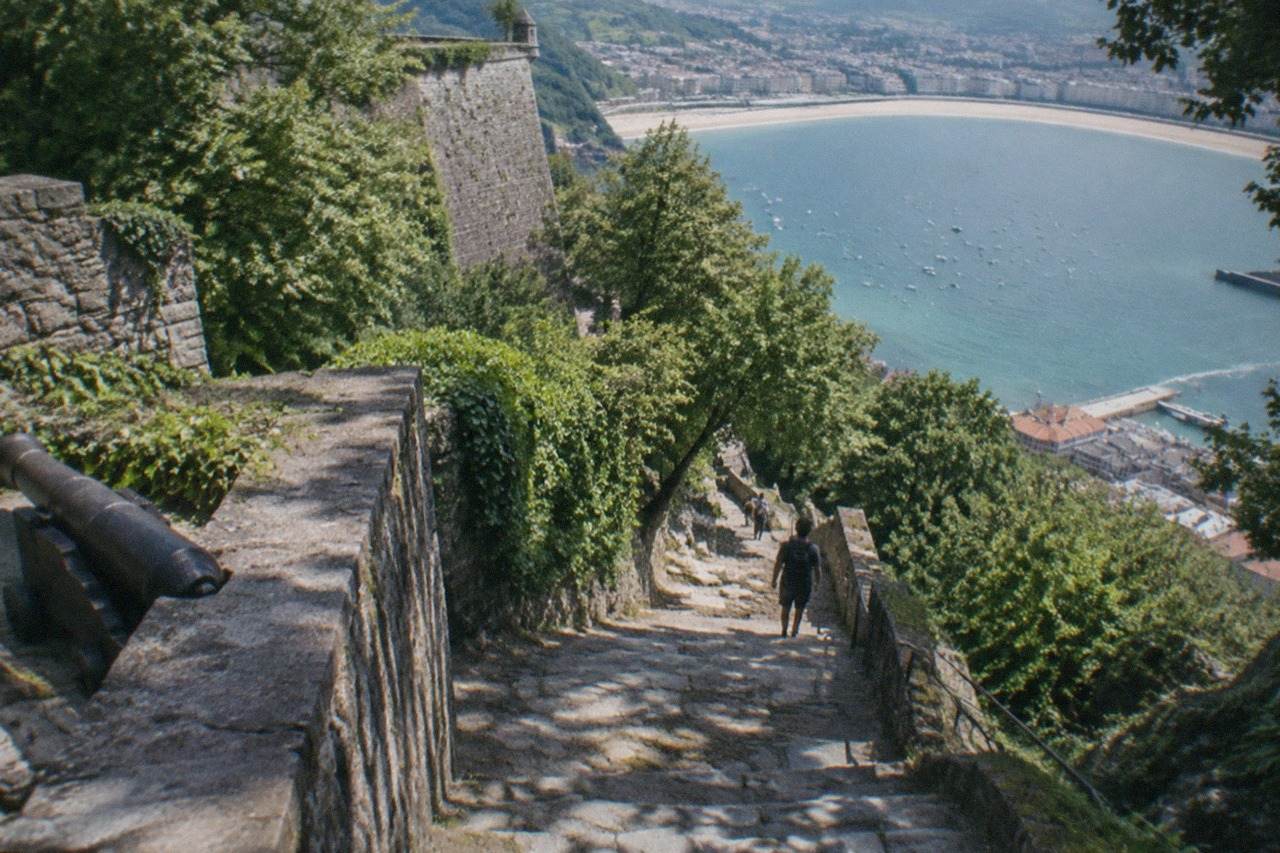
Monte Urgull is the tree-covered hill that guards the east side of La Concha bay in San Sebastián, the Basque Country city whose official name is Donostia / San Sebastián. It is not an alpine objective. It is a city hill with paved and dirt paths, a fortress on top, and views that rank among the best in Gipuzkoa. The question of how long the climb takes has no single published figure, because none is needed: the hill sits directly behind the Old Town, the paths start a few minutes from the seafront, and the tourism board's own page for the hill describes it as a walk, not a hike. What the official sources do fix precisely is when you can be up there, and that is the number that actually decides your visit.
How Long Does It Take To Climb Mount Urgull
There is no official walking time published for the climb, and the hill is small enough that route and pace decide the answer. Monte Urgull rises directly behind the Parte Vieja, the Old Town of San Sebastián, so the walk starts from streets you are already standing in. Most people describe it as a steady uphill stroll with pauses for the views, and the tourism board presents the hill as a city walk with a fortress at the top rather than as a hiking route.
That qualitative answer is the honest one, and this page will not invent a minute count that no official source gives. What can be said with confidence is what shapes the time it takes. The paths up are a mix of paved sections and worn dirt tracks through trees, so ordinary city shoes are usually fine in dry weather and less fine after rain. The hill's own access rules matter more than your fitness: the tourism board states that Monte Urgull is closed at night, open from 08:00 to 21:00 between 1 May and 30 September, and from 08:00 to 19:30 from 1 October to 30 April. Plan around those gates and the climb itself becomes the easy part of the outing.
If you want a sense of scale without a fabricated figure, think of Urgull as one of the city's three hills, alongside Monte Igueldo at the west end of the bay and the smaller Monte Ulia reaching out to the east. Urgull is the one you can start climbing from a pintxo bar. For a fuller picture of the hill and everything on it, see the Monte Urgull attraction guide.
Which Paths Lead Up Mount Urgull In San Sebastian?
The hill has more than one way up, and the one you choose changes the character of the walk far more than it changes the effort. Paths leave from the Old Town side, from the stretch around the aquarium at the foot of the hill, and from the Gros side beyond the river, and they meet near the top where the Castillo de la Mota stands.
The routes run through woods for much of the way, so the climb is shaded, and the surface alternates between paved stretches and packed earth.
The Old Town side is the classic approach. You leave the Parte Vieja's narrow streets, pass the aquarium at the base of the hill, and take the path that bends up through the trees. This is the route most first-time visitors take, because it starts where the city's life is and finishes at the fortress. On the far side, paths drop toward the Gros district and the mouth of the Urumea river, which makes a loop practical: up one side, along the ridge, down the other, and back along the seafront.
A few practical notes for the climb, none of which requires a stopwatch. The paths are used by locals jogging and walking dogs, which tells you the gradient is manageable rather than punishing. The tree cover means the hill stays cooler than the open seafront in summer, but also that the ground holds moisture after rain, and San Sebastián gets rain: AEMET's normals for its Igeldo station show 1,507 mm across the year spread over 141 rain days, with even July, the driest month, averaging 86 mm. After a wet spell the earth sections can be slick, so shoes with grip beat smooth-soled ones.
If you would rather have a guide set the pace and put the hill in context, a short guided walk is one option, and the city's flat layout makes it genuinely walkable, as the walkability of San Sebastian explains.
What Can You See From The Top Of Mount Urgull?
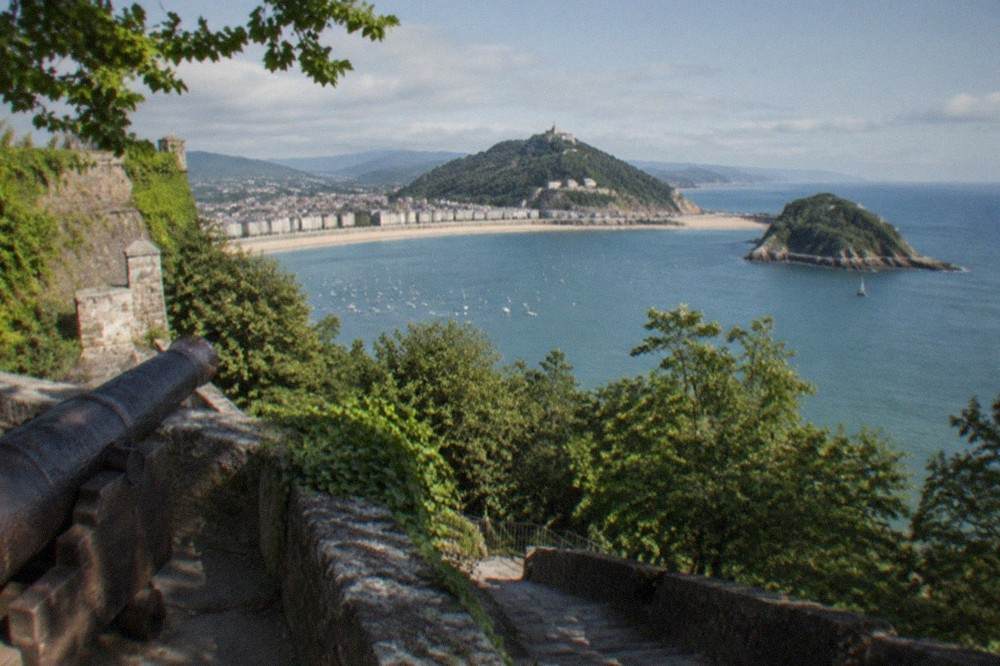
The summit area around the Castillo de la Mota gives you the whole of La Concha bay in one view: the beach and its island, Ondarreta and Monte Igueldo to the west, the Parte Vieja and the river mouth below, and Zurriola and the Gros district to the east. The Castillo de la Mota itself crowns the hill, and inside its walls sits the Casa de la Historia de Urgull, a small museum run by San Telmo, the city's principal museum.
The fortress is the reason the hill exists in the city's imagination. San Sebastián was a fortified garrison town, and Urgull was its eastern shield, with the castle built to command the bay's entrance. Today the structure is the viewpoint everyone climbs for, and the prospect from the walls takes in all three of the city's beaches. On a clear day the view runs along the Gipuzkoa coast, and the island of Santa Clara sits in the middle of the bay like a reference point for the whole panorama. Everything else covered here is indexed on San Sebastian Spain Guide.
The Casa de la Historia de Urgull tells the story of the hill and the city's military past. It is run by San Telmo Museoa, whose main building sits at the foot of the hill on the edge of the Old Town, and San Telmo's own page gives its main house hours and prices: general admission 10.00 EUR, reduced 4.00 EUR, free entry for everyone every Tuesday, closed Mondays outside holidays and long weekends. For the Casa de la Historia on the hill itself, check with San Telmo or the tourism board before you count on a visit, and treat the castle walls and the views as the certain part of the outing.
The table below gathers what the summit and the hill's surroundings offer, so you can plan what to do once you are up there.
| What | Where on the hill | What the sources say |
|---|---|---|
| Castillo de la Mota | The summit | The fortress that crowns the hill, open within the hill's access hours |
| Casa de la Historia de Urgull | Inside the castle | A small museum run by San Telmo Museoa |
| La Concha bay view | The summit walls | Takes in the beach, Santa Clara island and Monte Igueldo |
| Zurriola and Gros view | The eastern walls | Looks over the river mouth to the surf beach |
| Path network | All sides | Paved and dirt paths through woods, closed at night |
One pairing worth planning: the hill is a morning or sunset object, and the city below is an evening one. The Old Town pintxo crawl covers the streets you can see from the walls, and many visitors climb Urgull first and eat after.
When Is Monte Urgull Open, And When Does It Close?
Monte Urgull is closed at night, and the tourism board gives the hours precisely: access runs 08:00 to 21:00 from 1 May to 30 September, and 08:00 to 19:30 from 1 October to 30 April. That single rule is the most important planning fact on this page, because it means there is no pre-dawn climb and no starlit descent, and in winter the gates close well before dinner. Time your visit so you are down before the listed closing time, not at it.
The seasonal shift deserves a second look. In the summer months you have until nine in the evening, which comfortably covers a post-beach climb with the late light over the bay. From October the window pulls back to half past seven, which still leaves room after the working day but cuts out the long autumn dusks. The hill is not lit as a night attraction, and the tourism board's page treats the hours as access rules, not suggestions.
The same seasonal logic governs the rest of the bay, and it is worth seeing the pattern together:
| Season rule | Dates | Hours or terms |
|---|---|---|
| Monte Urgull access | 1 May to 30 September | 08:00 to 21:00 |
| Monte Urgull access | 1 October to 30 April | 08:00 to 19:30 |
| Beach lifeguards, all three beaches | 1 June to 30 September | 10:00 to 20:00 from 15 June to 15 September; 13:30 to 19:30 from 16 to 30 September |
| Santa Clara island boat high season | 1 June to 30 September | Departures weather and sea permitting; low season by enquiry |
| Hondalea, in the island lighthouse | 1 June to 30 September | 11:00 to 18:30, free, sessions every half hour |
Read the table as a single summer machine: from June to September the hill, the beaches and the island all run full seasons, and a day that starts with a swim can end with a climb and a boat. Outside that window the city does not shut down, but each piece shortens on its own schedule, and Urgull's October cut to 19:30 is the first sign of it.
What Should You Know Before You Climb Mount Urgull?
Take water, wear shoes with grip, check the sky, and go inside the access hours. The hill is shaded and steep in short bursts rather than long ones, the paths are shared with joggers and dog walkers, and rain is a routine fact of this coast rather than an exception, with every month of the year averaging at least 86 mm at the Igeldo weather station. None of this makes the climb hard; it makes it worth ten minutes of preparation.
Weather is the real variable. This is a wet Atlantic city, and the AEMET normals for the Igeldo station, which sits 250 m up on Monte Igeldo and so reads slightly cooler than the seafront, show November as the wettest month at 169 mm and July as the driest at 86 mm. A summer climb is more likely to be dry than a November one, but no month is a dry month here, and the tree cover that shades you in August holds mud in February. The reward cuts both ways: the view from the walls is at its clearest after rain has washed the air, and a break in the clouds is worth waiting for.
Footwear and timing are the two decisions. The dirt paths are fine in trainers when dry and slippery when wet, so on a grey day take the sturdier pair. As for when in the day, the access hours give you the whole range from 08:00 onward, and the light over the bay changes character across it: the morning sun comes from over the island, the afternoon lights up Monte Igueldo, and in summer the long evenings let you climb after the beach crowds have gone.
For visitors who want the hill explained rather than just climbed, a guided walk of the city centre pairs well with an independent Urgull ascent, and a short walk with a pintxo and a drink included is one way to book it.
You can also see the hill from the water, which is a useful corrective to the view from the top: the bay boat with a stop at Santa Clara gives you Urgull's full profile from the sea, fortress and all, and the island stop adds the one angle the walls cannot give you.
If the climb has sold you on the city's layout, the broader list of things to do in San Sebastian covers the beaches, the pintxo bars and the day trips that fill the rest of a stay. And if your trip involves arriving from further afield, the question of why the train from Bilbao to San Sebastian takes so long explains one of the oddities of getting here.
Common Questions About Climbing Mount Urgull In San Sebastian
How long does it take to climb Mount Urgull?
No official walking time is published for the climb, and the hill is small enough that route and pace decide the answer. It rises directly behind the Old Town of San Sebastián, the paths are a mix of paved and packed-earth track through trees, and the tourism board presents it as a city walk to a fortress rather than a hike. Plan around the access hours instead: 08:00 to 21:00 from 1 May to 30 September, and 08:00 to 19:30 from 1 October to 30 April.
Is Monte Urgull open at night?
No. The tourism board states that the hill is closed at night, with access from 08:00 to 21:00 in the summer window of 1 May to 30 September, and 08:00 to 19:30 from 1 October to 30 April. There is no pre-dawn or after-dark visiting.
What is at the top of Mount Urgull?
The Castillo de la Mota, the fortress that crowns the hill, with the Casa de la Historia de Urgull, a small museum run by San Telmo Museoa, inside its walls. The summit also gives the fullest view of La Concha bay, taking in the beach, Santa Clara island, Monte Igueldo and the surf beach Zurriola.
Is the climb up Mount Urgull difficult?
The official sources describe a walk, not a hike. The paths are steep in short sections rather than sustained, they are shared with joggers and dog walkers, and the tree cover keeps them shaded. Rain is the main complication: this coast averages 1,507 mm a year over 141 rain days, and the earth paths hold moisture after wet weather.
Where do the paths up Monte Urgull start?
Paths leave from the Old Town side around the aquarium at the foot of the hill, and from the Gros side beyond the river mouth, which makes a loop up one side and down the other a practical option. The Old Town approach is the one to take, since it starts in the Parte Vieja itself.
Can you combine Mount Urgull with Santa Clara island?
Yes, in the summer season. The island boat's high season runs 1 June to 30 September, with departures weather and sea permitting, and Hondalea in the island lighthouse is free and open over the same window with sessions every half hour. Outside the season the island boat runs only by enquiry.
The climb up Mount Urgull is one of those rare city walks where the effort is modest, the history is real, and the view hands you the whole of San Sebastián in a single turn of the head: go up inside the access hours, keep an eye on the sky, and give yourself more time at the walls than on the path.