What Time Do People Eat Pintxos In San Sebastian?
Pintxo eating hours in San Sebastián, Basque Country, Spain, covering the midday and evening waves, the txikiteo crawl custom, and how visitor hours drift from local ones.
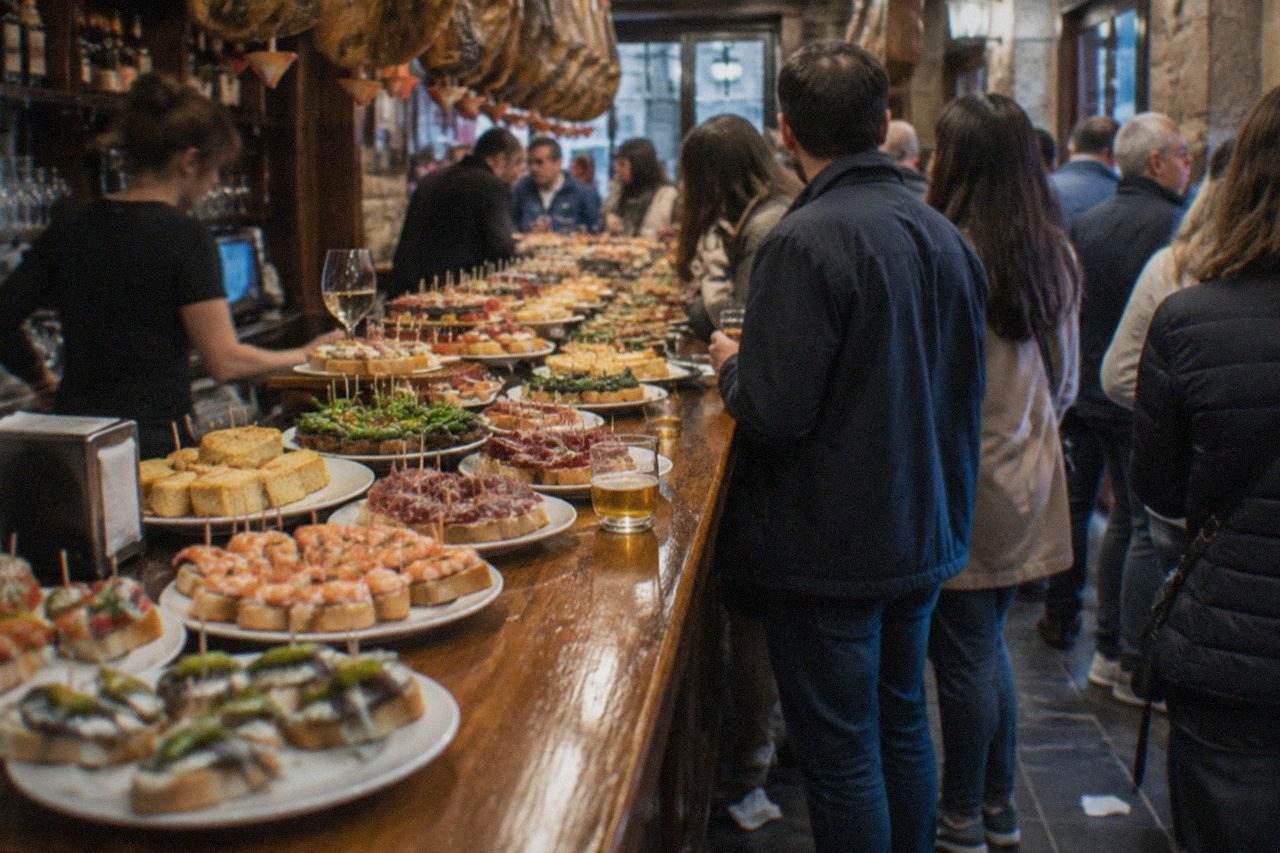
Pintxo eating in San Sebastián, the Basque city on La Concha bay whose official name is Donostia / San Sebastián, runs on the Spanish clock, not on a northern European one. The city's Basque name, Donostia, is worth knowing here because the custom this page describes, the evening bar crawl from counter to counter, is a local institution with a Basque word of its own: the txikiteo. Nobody in the Parte Vieja eats dinner at six in the evening. The bars are quiet then, the kitchens are not yet busy, and the first serious wave of eaters does not arrive until the Spanish dinner hour begins to approach. A visitor who plans the day around the local rhythm gets a completely different city from one who does not.
What Time Do People Eat Pintxos In San Sebastian?
Locals in San Sebastián eat pintxos in two main waves: a midday wave that builds from around one o'clock and peaks around two, when office workers and families fill the Old Town counters, and an evening wave that starts near eight o'clock and runs well past ten, with the txikiteo crowd moving from bar to bar. Pintxos are eaten standing at the counter, not seated at a table, and the crawl is the point: one bar, one pintxo, one small drink, then the next bar.
That is the honest shape of the day. The afternoon gap between roughly four and seven is the quietest stretch in the Parte Vieja, and a visitor who arrives then finds half-empty bars and a kitchen staff that is visibly resetting for the night. The evening is when the custom comes alive. Groups stand shoulder to shoulder at the counter, order by pointing at the glass display case or the trays on the bar top, eat in a few bites, settle up, and drift to the next doorway. The whole thing looks chaotic from the outside and runs on a precise internal logic once you are inside it.
If the timing sounds like a scheduling problem, it is worth reading what pintxos actually are before planning a first crawl, because the format explains the hours. A pintxo is a small portion, often skewered on a cocktail stick, designed to be eaten in two or three bites with a drink in the other hand. It is not a sit-down course. Nobody books a table for it.
When Do Pintxo Bars Fill Up In The Parte Vieja?
The Old Town, the Parte Vieja, fills twice a day: at lunchtime, with the busiest stretch between about one and three o'clock, and in the evening, when the crowd builds from around eight and the bars stay busy until midnight or later, especially from Thursday to Saturday. Sunday midday is also a strong pintxo moment, as families eat out after the morning. The counter, not the dining room, is where the action is.
The rhythm inside a single bar is easy to read once you know it. Early in the evening wave the display cases are full and the counter staff have time to explain what is on the trays. By ten o'clock the same bar can be three deep, the floor is a scatter of napkins and cocktail sticks, and ordering becomes a matter of catching the bar worker's eye. Regulars treat this as normal. The stick pile on the counter or the floor is how the bar counts what you have eaten, so the custom is to keep your sticks until asked for them. Other pages covering the same trip are gathered on San Sebastian Spain Guide.
Weather shapes the crawl more than visitors expect. San Sebastián is an Atlantic city, not a Mediterranean one: AEMET's normals for its Igeldo station record 1,507 mm of rain a year over 141 rain days, and even July, the driest month, averages 86 mm. On a wet evening the crawl compresses into whatever bars are closest together, and the streets empty between doorways fast.
A guided crawl solves the timing question for a first visit, because the guide already knows which counter is worth standing at when.
What Is The Difference Between Pintxos At Lunch And At Night?
At midday, pintxos work as a fast lunch: workers eat two or three with a drink and are back at their desks within the hour, so the pace is quicker and the crowd thins by three. At night, pintxos are the whole evening: the crawl stretches across hours, groups linger, conversation matters more than speed, and the last orders come late. The food overlaps, but the social job it does is different.
The table below shows how the same custom changes shape across the day.
| Moment of the day | Who is at the counter | How it works | What it is for |
|---|---|---|---|
| Midday, about one to three | Office workers, shoppers, families | Two or three pintxos and a small drink, eaten quickly standing up | A fast lunch |
| Late afternoon, about four to seven | Few people, mostly visitors | Bars quiet, kitchens resetting | A rest period |
| Evening, from about eight | Groups of friends, couples, txikiteo crawlers | One pintxo and one drink per bar, moving door to door | The evening itself |
| Late, from about eleven | The tail of the crawl, night owls | Fewer bars open, orders slow down | The last stop |
One detail surprises many visitors: the evening pintxo wave is not dinner, or not only dinner. Plenty of locals make a full meal of the crawl, others eat pintxos as a prelude to a later sit-down dinner, and the two habits coexist in the same streets. The pintxo scene in San Sebastián covers this split in more depth, including how the sit-down restaurant hour sits even later than the crawl.
How Do Local Eating Hours Compare With Tourist Hours?
Visitors tend to eat two to three hours earlier than locals: a tourist crowd gathers at six or seven in the evening, when the bars are still half empty, while the local wave only builds from eight onwards. At midday the gap is smaller, because hunger pulls everyone toward two o'clock. Bars that sit on the main Old Town streets adapt to the earlier tourist appetite, but the deeper you go into the side streets, the more strictly the Spanish clock holds.
The mismatch is not rudeness, it is logistics. A bar that is slammed at ten at night cannot also run a full kitchen at six. Visitors who shift their evening an hour or two later are usually rewarded with the atmosphere they came for, and the question of how much pintxos cost matters more once you understand that a crawl can mean five or six stops, each with a small drink.
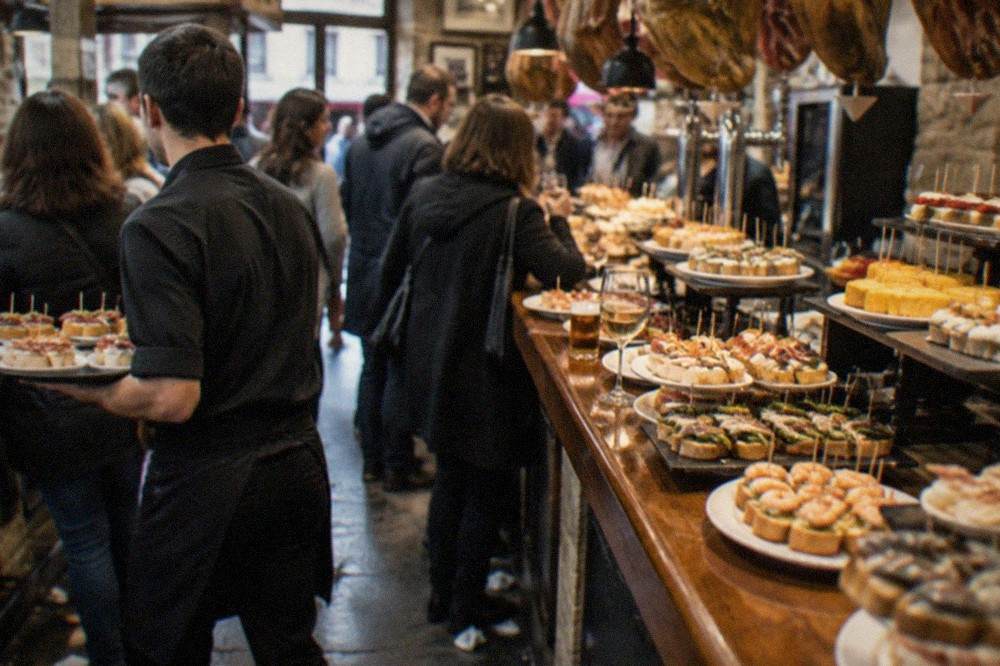
Season bends the clock too. August is the city's busiest hotel month in the INE series, with 245,769 hotel overnight stays in 2025, the year's peak, and Semana Grande always falls in the week of 15 August. In that week the evening crawl starts earlier and runs later simply because the streets are full from dusk. By contrast, in the shoulder months the Old Town quiets earlier and some bars pull their shutters sooner.
What Should First-Time Visitors Know About Ordering Pintxos?
Order at the counter, not from a table, and pay at the end or when the bar worker asks: many bars tally your sticks and glasses rather than ringing up each round. Point at what you want in the display case, ask for the hot items, which are often made to order, and keep your used sticks in view. Say the pintxo's name if you can, or simply point, and expect to pay per item rather than per plate. The custom rewards boldness over fluency.
A few habits make the first crawl easier. Eat one pintxo and one drink per bar and move on, which is the local rhythm, rather than settling into a single counter for the night. Go in a small group, because the crawl is social. And do not expect every bar to serve the same things: each house has its speciality, and part of the skill of the txikiteo is knowing which counter does which thing best. The best pintxo bars are covered on their own page, and the gilda pintxo, the anchovy, guindilla pepper and olive skewer, is the classic example of a house speciality that travels bar to bar.
For visitors who want the timing and the ordering decoded for them, a guided tour is the shortcut that makes sense on a short stay.
A guided crawl also answers the standing-versus-seated question in practice. The tour moves at the local hour, hits counters in an order that avoids the worst crush, and shows how the stick tally works before you have to work it out alone at ten at night.
Common Questions About Pintxo Times In San Sebastian
What time do people eat pintxos in San Sebastian?
Locals eat pintxos in two waves: a midday wave that peaks around two o'clock, and an evening wave that builds from about eight and runs past ten. Pintxos are eaten standing at the counter, moving from bar to bar.
Are pintxo bars open all afternoon in San Sebastian?
The late afternoon, roughly four to seven, is the quietest stretch in the Old Town. Many bars stay open but the kitchens reset, and the serious eating resumes with the evening wave.
Is eating pintxos the same as eating dinner in San Sebastian?
For many locals the evening crawl is dinner, made up of several small stops. Others treat it as a prelude to a later sit-down meal. Both patterns happen in the same streets on the same night.
Do tourists and locals eat pintxos at the same time?
Not quite. Visitors tend to arrive two to three hours earlier than the local evening wave. Shifting the evening later usually means joining the atmosphere the crawl is known for.
Which day of the week is best for a pintxo crawl in San Sebastian?
Thursday to Saturday evenings are the busiest and liveliest, and Sunday midday is also a strong pintxo moment for families. Weekday evenings are calmer and easier for a first crawl.
The timing is the whole trick of the thing: arrive when the locals arrive, eat the way they eat, standing up and on the move, and the pintxo hours of San Sebastián stop feeling like a puzzle and start feeling like the evening itself.