Is Train From San Sebastian To Barcelona Pretty?
Is the train from San Sebastián to Barcelona pretty? An honest look at what the window shows on the route from the Basque Country to Catalonia, and when the views are at their best.
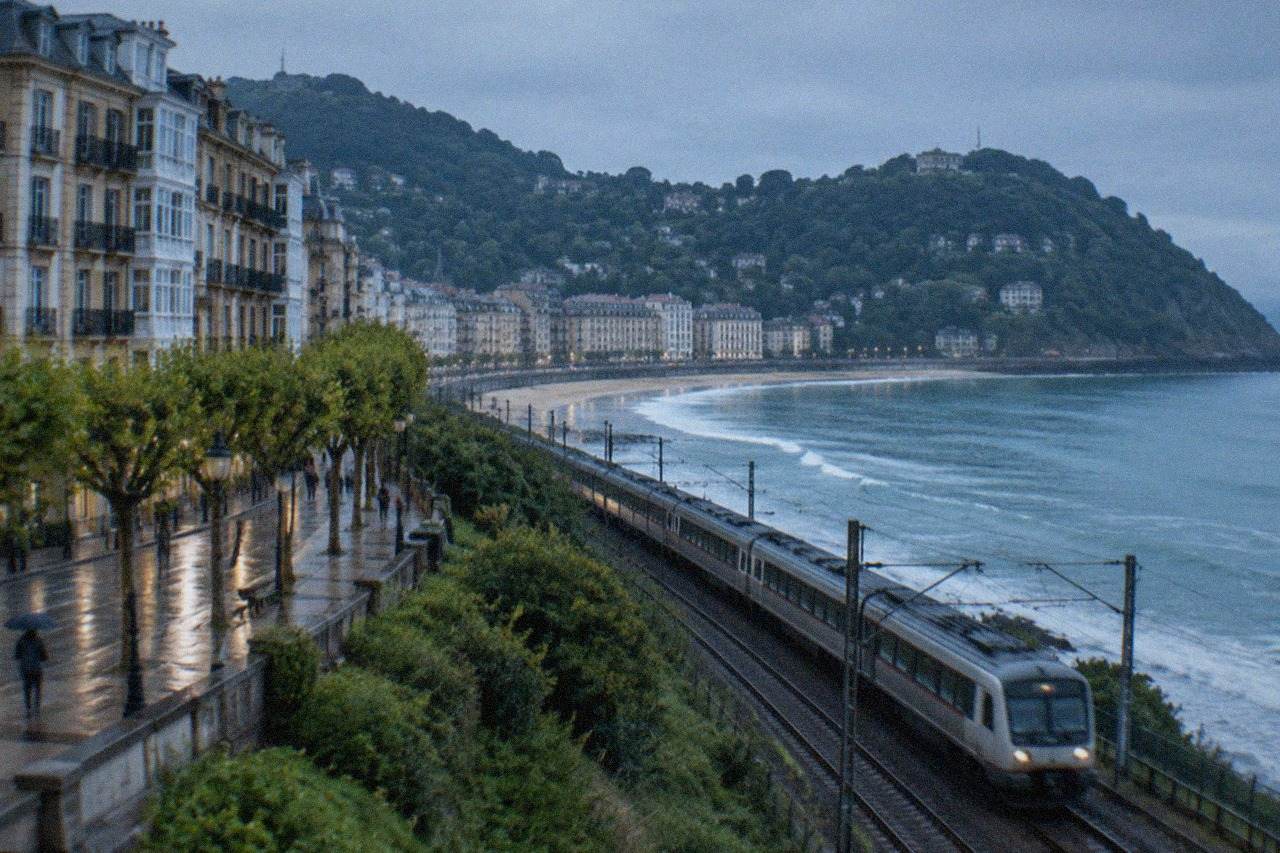
The train from San Sebastián, the Basque city on La Concha bay whose official name is Donostia / San Sebastián, to Barcelona is a long ride that earns the word "pretty" in some stretches and not in others. It is not a scenic railway in the Alpine sense. What it offers instead is a slow cross-section of northern Spain: green Basque hills, the wide Ebro valley, and the dry Catalan interior, watched from a window rather than a viewpoint. Whether that is worth the hours in the seat depends on what a traveller wants from a train ride in the first place.
The question matters more here than on most Spanish routes, because the country's high-speed network does not serve this city directly, and the conventional alternatives involve changes. Riders weighing the seat against the plane often land on is it better to fly or take the train from Barcelona to San Sebastian, and the view from the window is one of the few things the train can offer that a flight cannot.
Is Train From San Sebastian To Barcelona Pretty?
Yes, in stretches, and the prettiest of them are at the Basque end. The ride out of San Sebastián climbs through green hill country that AEMET's Igeldo station records as receiving 1,507 mm of rain a year, which is exactly why it looks the way it does. Further along, the route crosses the Ebro valley and the drier interior before the final run into Catalonia. It is a varied ride, not a continuous panorama.
The honest framing is this: the Basque Country is one of the greenest corners of Spain, and the railway leaves through it. AEMET's climate normals for its Donostia / San Sebastián, Igeldo station show 141 days a year with at least 1 mm of rain and a mean temperature that never climbs above a monthly average of 19.5 C even in August. That climate produces the landscape the window shows for the first part of the journey: pasture, stands of trees, and hills that stay green when most of the rest of Spain has already gone brown.
After the Basque stretch the character changes. The train works its way south and east through Navarra and La Rioja country and into the Ebro basin, and the greens give way to cereal plain, vineyard and low ridge. None of this is dramatic, but it is real Spain in a way the high-speed lines, which spend much of their time in tunnels and on viaducts, do not manage. The last section approaches Barcelona through the Catalan interior and, depending on the routing and the light, the hills above the Mediterranean plain.
The comparison worth making is with the Madrid ride, which crosses the high meseta. Riders who have taken that route can read is the train ride from Madrid to San Sebastian scenic and will recognise the difference at once: the Madrid line is about distance and plain, while the route east is about green hills giving way to valley country.
Which Part Of The San Sebastian To Barcelona Route Is The Most Scenic?
The Basque section, from departure until the line leaves the green hill country, is the most scenic part of the ride. The window shows wooded slopes, small river valleys and pasture that stays green because the region records rain on roughly ten days a month even in July, its driest month. The middle of the journey, across the Ebro valley, is open and agricultural, pleasant rather than striking.
The geography explains the ranking. San Sebastián sits on a bay on the Atlantic-facing coast of Gipuzkoa, and the province behind it is small, steep and wet. AEMET's Igeldo station, 250 m up on Monte Igeldo, records November as the wettest month at 169 mm and July as the driest at 86 mm, and even July averages about ten rain days. A landscape that gets that much water, that evenly spread through the year, is a landscape of permanent green, and the railway runs straight through it on its way out of the region.
The table below shows the climate the first stretch of the route sits inside, using AEMET's published normals for the Igeldo station, period 1981 to 2010. The numbers explain both the greenery and the practical point that a wet month can turn the best part of the ride into a window of grey.
| Month | Mean temp C | Rain mm | Rain days 1 mm+ | Sun hours |
|---|---|---|---|---|
| January | 8.5 | 141 | 13.2 | 98 |
| March | 10.3 | 113 | 12.4 | 144 |
| May | 14.4 | 120 | 12.2 | 181 |
| July | 18.9 | 86 | 9.8 | 196 |
| September | 18.0 | 111 | 10.1 | 179 |
| November | 11.3 | 169 | 13.0 | 102 |
Two readings follow from that table. First, there is no dry month at the Basque end of the line: July, the driest, still averages 86 mm of rain over 9.8 rain days, so the green in the window is not a seasonal decoration, it is the permanent condition. Second, the sun-hours column matters more than the temperature column for a train ride, because 196 hours of July sun against 93 in December is the difference between seeing the hills and seeing cloud sitting on them.
Riders planning the wider rail picture around the city can also check is there a high speed train to San Sebastian, because the answer shapes how much of the journey east happens on conventional track, and conventional track is where the scenery lives.
For travellers with a spare day in the city before departure, the countryside the train crosses is also reachable on foot or with a guide, and the picks below are the ones that fit the same landscape.
Where Does The Train From San Sebastian To Barcelona Start?
The long-distance ride begins at the city's Renfe station, which sits at the eastern edge of the centre, within walking distance of the Old Town and the Urumea river. Locally the rail picture has two systems: the Renfe station for the national network, and the Euskotren Topo, which runs from Amara-Donostia to Hendaia in 37 to 38 minutes for a 2.90 EUR occasional fare. A traveller heading for Barcelona uses the Renfe side.
The station area itself is worth a few minutes before departure. The river mouth, the Kursaal congress centre on the far bank, and the start of the Zurriola beach stretch are all close by, and the Kursaal, designed by Rafael Moneo and officially inaugurated in 1999, is one of the city's most recognisable modern buildings. The first minutes of the ride east run along the Urumea and then out through the eastern suburbs, which is a gentle start rather than a scenic one.
The Topo's own story is worth knowing so it does not confuse the plans. The Basque Government announced on 8 June 2026 that the civil works of the new underground through-line, including the station beside La Concha, are complete and that fitting-out has begun, but it published no opening date, and Amara remains the working terminus. None of that affects a Barcelona departure, which leaves from the Renfe side of the city's rail system.
The practical detail is timing. Because the pretty part of the ride is the Basque stretch, a morning departure puts the green hills in the better light, while an evening departure gives the same hills in shadow or worse. Riders with a choice should spend the first hour at the window and save the book for the Ebro valley.
Is The Train Ride Worth It For The Views Alone?
For many travellers, no, but for some, yes. The ride is pretty in parts, genuinely so at the Basque end, but it is a long journey with changes on most routings, and the scenery alone does not justify the extra hours for someone who values time over the window. It does justify the train for riders who enjoy slow cross-country rail or who want to see how green the north is compared with the interior.
The contrast the window delivers is the real argument. The city itself holds 11 Michelin stars across 6 restaurants in the MICHELIN Guide Spain 2026, and it sits in a province, Gipuzkoa, that holds 19 stars across 11 restaurants, which is a measure of how much wealth, food culture and rainfall the green corner of Spain packs in. Then the train climbs away and spends hours showing the other Spain: dry plain, vineyard, low ridge, and the long agricultural corridors of the Ebro basin. Few journeys in the country show that transition as clearly.
A useful way to think about it: the ride is a documentary about Spanish geography, watched at ground level. Riders who found why does the train from Bilbao to San Sebastian take so long interesting will recognise the theme, because the whole northern network shares the same condition, terrain that was never flattened for the railway.
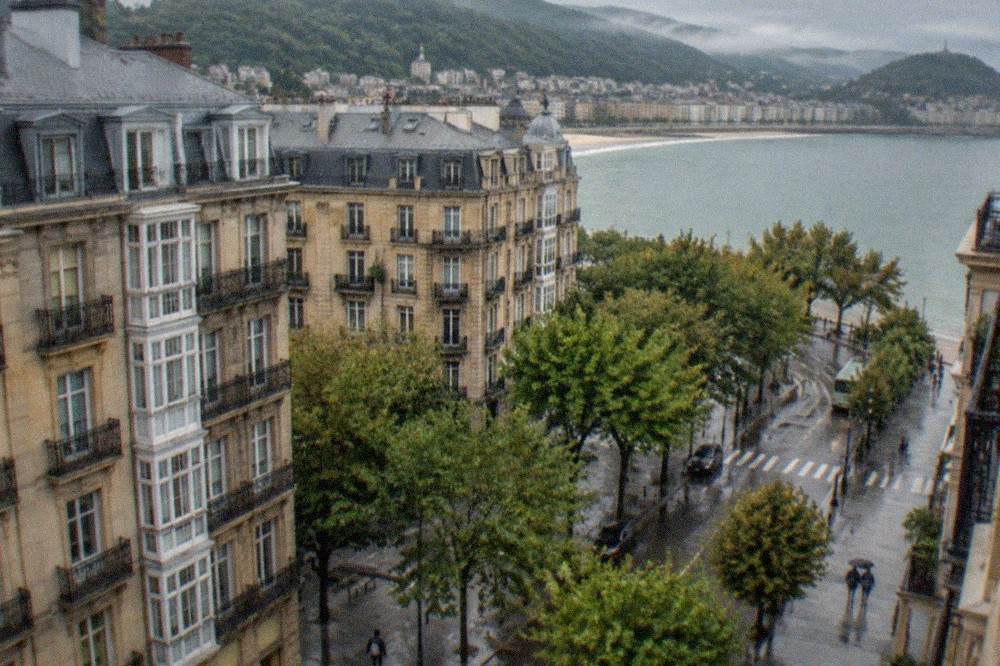
The season changes the answer too. AEMET's Igeldo normals show the seafront city itself has sunshine totals from 93 hours in December to 196 in July, and the hills the train crosses sit inside the same weather system. A July or September ride gives the best chance of seeing the Basque stretch in full colour; a November ride, in the wettest month at 169 mm, risks spending the prettiest hour under cloud.
What Can You See From The Window On Each Stretch?
The ride breaks into four visual stretches: the green Basque hills at the start, the Navarra and Rioja country as the line turns south and east, the wide Ebro valley with its farmland and low ridges, and the Catalan interior on the approach to Barcelona. Each stretch has its own character, and the table below describes what the window shows in each, so a rider can plan where to stay awake.
The first stretch is the one to protect. The Basque Country that the train leaves behind is the same landscape that the coastal Camino de Santiago route crosses, the route UNESCO inscribes as part of the Routes of Northern Spain, and the same wet Atlantic climate that keeps it green also means the mist can sit in the valleys on an early morning. Mist on green hills is its own kind of pretty, but it is not the postcard version.
The middle of the ride is where expectations need managing. The Ebro valley is wide, flat and worked, and for riders used to mountain railways it can feel long. This is the stretch for lunch, for the book, and for the walk down the corridor, because the window is doing background rather than foreground.
The end has its own payoff. The approach into Barcelona brings the dry Catalan hills and then the plain, and the arrival itself, crossing a major city by rail at ground level, has a pace that an airport never offers. Riders continuing their planning afterwards can pick up the full route picture at Barcelona to San Sebastian, which covers the journey in both directions.
For travellers who want the Basque countryside at walking pace rather than through glass, the options below are the ones that go deepest into it.
The sculpture park at Chillida Leku sits in Hernani, a separate municipality outside the city, and the guided visit is the calmest possible contrast with a long day on the train: art in a landscape rather than scenery at speed. Between the two, the cider house run and the surf-and-pintxos combination cover the other two registers of the same green country, the table and the wave.
Common Questions About The San Sebastian To Barcelona Train
Is train from San Sebastian to Barcelona pretty?
Yes, in stretches, and the prettiest part is the Basque hill country the line leaves through, kept green by 1,507 mm of annual rain at AEMET's Igeldo station. The middle of the ride crosses the open Ebro valley, which is pleasant rather than striking, and the final stretch runs through the dry Catalan interior into Barcelona.
Which seat side has the best views?
The pack for this page does not give a seat-side recommendation for this specific route, and the line changes direction more than once, so no reliable single answer exists. The practical rule is to spend the first hour on whichever side faces open country rather than cuttings and embankments, and to move if the window is showing nothing but hedge.
Is the train or the plane better for scenery?
The train, by a wide margin. A flight shows the coastline for minutes at most, while the rail crossing spends hours on the ground in the Basque hills, the Navarra countryside and the Ebro valley. The trade is time: the train takes far longer and usually involves changes, so riders weighing the two can read the fly-or-train comparison before booking.
When is the scenery at its best?
In the warmer, sunnier months. AEMET's Igeldo normals give July 196 sun hours and December 93, and November, the wettest month at 169 mm, can hide the green hills under cloud. A morning departure in July, August or September gives the best chance of the first stretch in full colour.
Does the ride pass the Basque Coast Geopark?
No. The Basque Coast UNESCO Global Geopark covers Zumaia, Deba and Mutriku on the coast further east, and the railway does not run through it. Travellers who want the flysch cliffs should plan a separate day trip, because the train window does not deliver them.
The short answer to the page's own question is a qualified yes: the ride out of San Sebastián is pretty, the middle is patient, and the end is urban. For a traveller who likes trains, that arc is the point of the journey, and this San Sebastian Spain Guide covers the rest of the rail picture, the stations and the routes from every direction, for riders building the wider itinerary around it.