How Far Is The Camino Del Norte From San Sebastian To Bilbao?
The Camino del Norte leaves San Sebastián heading west along the Gipuzkoa coast toward Bilbao. What the official stage list says, how the route runs, and how to walk parts of it.
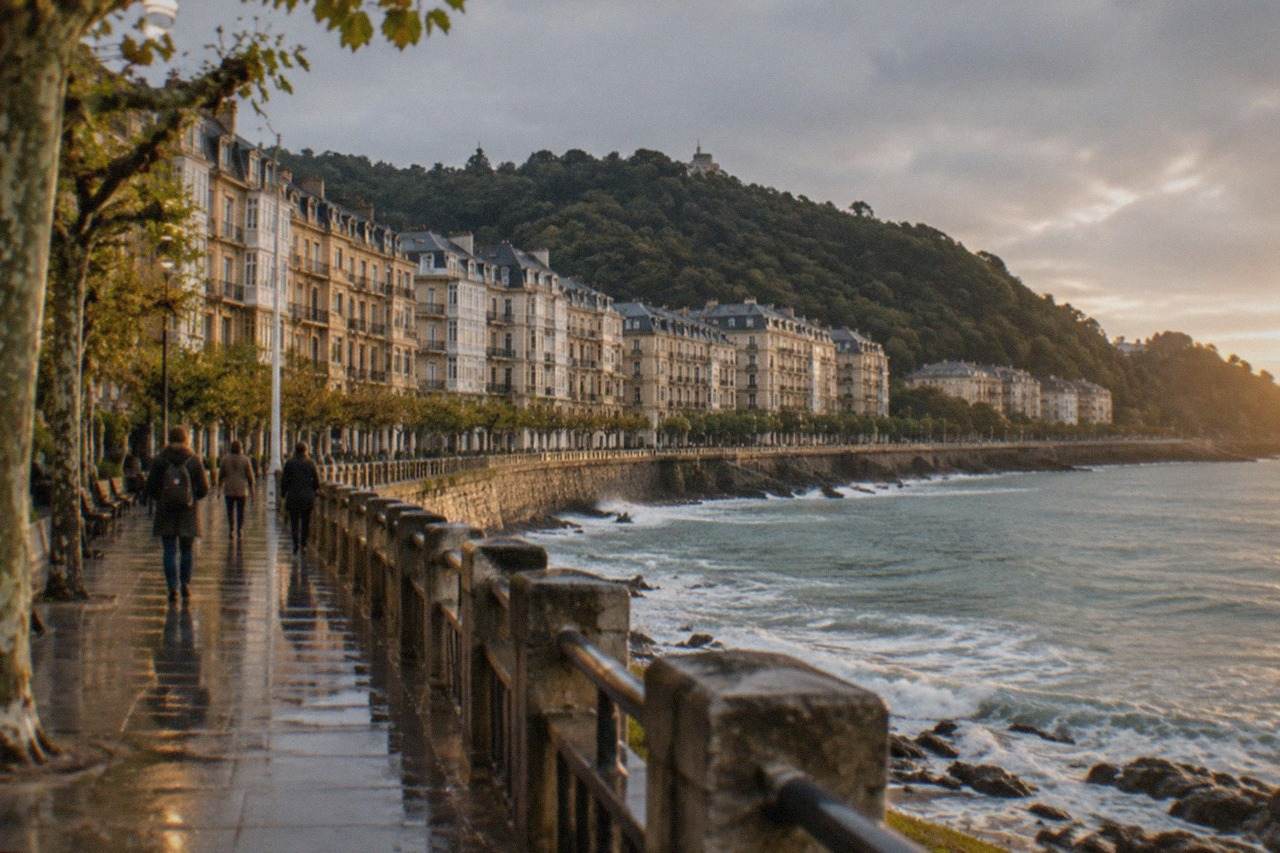
The Camino del Norte, the northern coastal route of the Camino de Santiago, runs through San Sebastián, the Basque city on La Concha bay in Gipuzkoa, Spain, whose official name is Donostia / San Sebastián. Pilgrims reach the city on the stage from Pasaia and leave it on the stage toward Orio, then follow the Gipuzkoa coast west through Zarautz, Getaria and Zumaia before the route turns inland through Itziar and Deba on its long way toward Bilbao and beyond. The honest answer to how far that stretch is: the tourism board's own coastal stage list gives the stages by name and gives no distances at all, so any single kilometre figure you have seen for San Sebastián to Bilbao is someone's estimate, not an official number.
How Far Is The Camino Del Norte From San Sebastian To Bilbao?
There is no official distance for the Camino del Norte between San Sebastián and Bilbao: the tourism board's coastal stage list names each stage but gives no kilometres for any of them. What is official is the shape of the route: the city sits on stages two and three of the six-stage Gipuzkoa coastal sequence, and from Zumaia the route continues through Itziar and Deba before turning toward Biscay. Any specific number for the full stretch is an estimate, not a sourced fact.
That may feel like an evasion, but it is the opposite. The tourism board for San Sebastián publishes the coastal route's stages as a list of place names: Irun, Hondarribia, Lezo and Pasaia; then Pasaia to Donostia; then Donostia to Orio; then Orio to Zarautz; then Zarautz to Getaria to Zumaia; then Zumaia to Itziar to Deba. Six stages, and not one of them carries a distance on that page. Guidebooks and apps print their own kilometre counts for these stages, and those counts differ from one another, which is exactly why this page does not repeat one. If you need a figure for planning, the practical move is to open a current Camino guide or app on the day and treat its number as an estimate, because the official list simply does not carry one.
What can be said with certainty is the structure. San Sebastián is a waypoint, not a start or an end: the route arrives from the east, from the French border at Irun through the fishing port of Pasaia, and departs to the west along the coast toward Orio. From Deba, the last named stage in Gipuzkoa, the Camino del Norte continues into Biscay province and eventually reaches Bilbao, a city that is itself a common base for walkers, as the comparisons in is it better to stay in Bilbao or San Sebastián make clear. The stretch from the city to Bilbao therefore covers most of the Gipuzkoa coastline plus a further stretch in Biscay, and it is normally walked over multiple days rather than one.
What The Official Stage List Says From San Sebastian
The official coastal stage list runs Irun to Hondarribia to Lezo to Pasaia, then Pasaia to Donostia, then Donostia to Orio, then Orio to Zarautz, then Zarautz to Getaria to Zumaia, and finally Zumaia to Itziar to Deba. San Sebastián appears on the second and third of those six stages, arriving from Pasaia and leaving toward Orio. The list is the tourism board's own, it names no distances, and it ends at Deba, which is still short of Bilbao.
The table below shows the stages exactly as the tourism board lists them, with what each one means for a walker based in the city.
| Stage | Places on the stage | Where it leaves you |
|---|---|---|
| 1 | Irun, Hondarribia, Lezo, Pasaia | At the harbour of Pasaia, east of the city |
| 2 | Pasaia to Donostia | In San Sebastián itself |
| 3 | Donostia to Orio | At the seaside town of Orio, west of the city |
| 4 | Orio to Zarautz | On the long beach town of Zarautz |
| 5 | Zarautz, Getaria, Zumaia | At Zumaia, inside the Basque Coast Geopark area |
| 6 | Zumaia, Itziar, Deba | At Deba, the end of the listed Gipuzkoa stages |
Two things about that list matter for planning. First, the city is stage two's destination and stage three's start, so a walker who wants a taste of the Camino without committing to a week can walk stage two in, spend a night, and walk stage three out, which is the Orio leg. Second, the list stops at Deba. Bilbao is further on, in Biscay, and the official Gipuzkoa page says nothing about the Biscay stretch, which is another reason no end-to-end figure belongs on this page.
The route also carries the region's only World Heritage connection. The UNESCO inscription is "Routes of Santiago de Compostela: Camino Francés and Routes of Northern Spain", list number 669, and the northern routes include the coastal route that crosses the city. San Sebastián itself is not a World Heritage Site, and no monument in it is inscribed on its own, so the Camino is the city's one genuine link to the list. Walkers with an interest in the full route will find more detail on the Camino del Norte guide.
Can You Walk The Camino Del Norte From San Sebastian In One Day?
You cannot walk the full stretch from San Sebastián to Bilbao in one day, because it is a multi-day section of a long-distance pilgrimage route covering most of the Gipuzkoa coast plus a further stretch in Biscay. What you can do in one day is walk a piece of it: the stage out of the city toward Orio, or a guided section with transport arranged back, which several local operators offer. The official stage list is built for multi-day walkers with luggage and accommodation plans.
The realistic one-day options are worth spelling out. The stage from the city to Orio is the natural first leg: it follows the coast west, passes the Peine del Viento at the foot of Monte Igueldo, whose three steel sculptures by Eduardo Chillida were given to the city in 1977, and continues along the shore toward Ondarreta and out toward Orio. Walkers who want the Camino's feel without its logistics can instead join a guided coastal walk: the Coastal Winery Camino Trail walk from the city is exactly this, a guided walk on Camino country with a market tasting, three txakoli tastings at a winery and a train ticket back to the city included, so the return leg is solved for you. Everything else covered here is indexed on San Sebastian Spain Guide.
If you would rather walk independently, plan around the weather rather than around a distance. AEMET's climate normals for its Igeldo station, the period 1981 to 2010, recorded at 250 m on Monte Igueldo, show what the coast does: 1,507 mm of rain a year over 141 rain days, with November the wettest month at 169 mm and July the driest at 86 mm over about ten rain days. There is no dry season here. Even the driest month averages rain on roughly ten days, so a Camino day out of the city needs a rain layer in any month, and the seafront runs slightly warmer than the station values because the station sits well up the hill.
Should You Walk To Bilbao Or Visit It As A Day Trip?
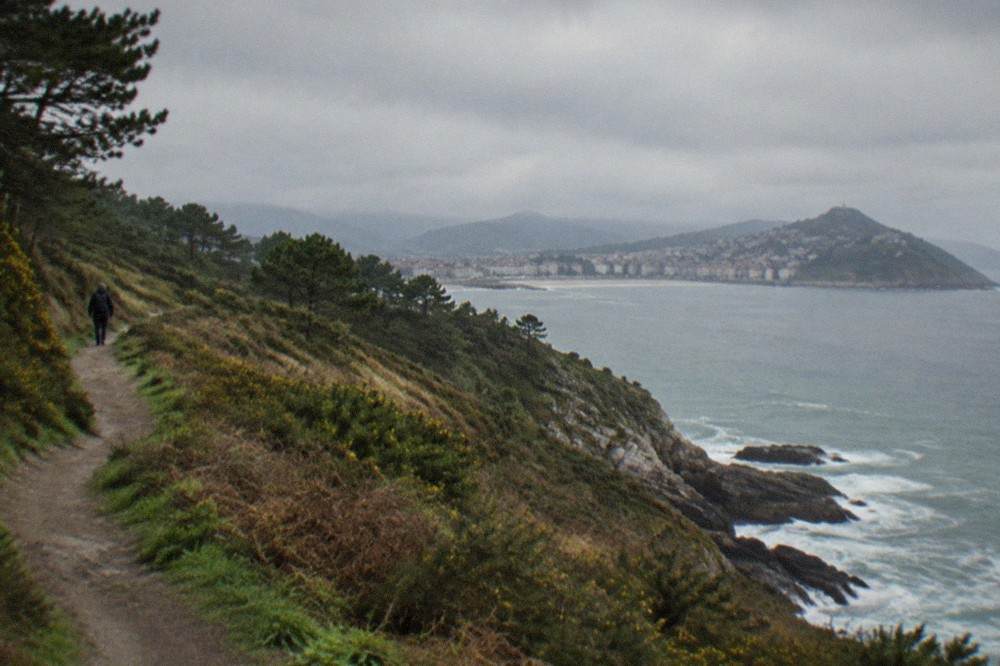
For many visitors the practical answer is a day trip, not a walk: the Camino del Norte between San Sebastián and Bilbao is a multi-day commitment across two provinces, while Bilbao sits close enough to the city for a straightforward excursion by coach or tour. Walking the full stretch suits pilgrims with a week and a luggage plan. Everyone else gets more from Bilbao, and the Guggenheim, by going there directly and saving the walking for the coastal stages around the city.
The trade-off is simple. A pilgrimage-style walk means booking beds night after night along the coast, carrying gear through a wet Atlantic climate, and giving most of a week to the Gipuzkoa shoreline before Biscay even begins. A day trip means one morning's travel, a full afternoon at the Guggenheim or in the Casco Viejo, and a return to the city's pintxo bars by evening. The Bilbao day trip guide covers the excursion in detail, and the Guggenheim Bilbao page covers the museum that draws travelers there. There is also a middle path: a small-group tour from the city to the Gaztelugatxe hermitage and Bilbao, which handles the transport and leaves the coastal drama for the part of the coast where it peaks.
For walkers set on the full route, the honest planning frame is this: treat the six listed Gipuzkoa stages as the spine, expect rain on any given day, and book the coastal towns early in summer, because August is the peak month for the region's hotels. The INE hotel figures for the city itself show the pattern: August 2025 recorded 245,769 overnight stays, the year's peak, against 115,910 in January. Those are city hotel numbers, but the coastal towns on the Camino stages fill on the same calendar, so a July or August walk wants beds reserved well ahead.
What Makes The Coastal Stages Worth The Walking?
The Gipuzkoa stages of the Camino del Norte are worth walking for the shoreline itself: the route strings together Pasaia's working harbour, the city's own bay, the Peine del Viento sculptures, the long beach at Zarautz, the fishing town of Getaria and the flysch cliffs at Zumaia, inside the Basque Coast UNESCO Global Geopark, a member of the geopark networks since 2010 and a UNESCO Global Geopark since 2015. That density of coast, food towns and geology is unusual for a pilgrimage route.
The food towns are a real part of the draw. Getaria, on stage five, is both a txakoli wine town and the home of the Cristóbal Balenciaga Museoa, which charges 14 EUR general admission, 9 EUR reduced, and opens Tuesday to Sunday from 10:30 to 18:00 from April to October, daily from 10:30 to 20:00 in July and August, and Wednesday to Sunday from 10:30 to 17:00 from November to March. Zarautz, on stage four, fronts one of the longest beaches on this coast. Zumaia, the end of stage five, is the gateway to the flysch, the layered rock formations of the Geopark, which spans Zumaia, Deba and Mutriku and is a day trip from the city in its own right. None of these towns is in San Sebastián: each is a separate municipality, and the Camino is what threads them together.
The city's own stretch of the route has its own character. Stage two arrives from Pasaia over the hills east of the city, and stage three leaves along the bay, past Ondarreta and the Peine del Viento, then climbs the coastal path toward Orio. For a walker, that makes the city both a rest point and a highlight, and for a visitor with no pilgrimage plans at all, the coastal stages are the most walkable taste of the Camino del Norte available anywhere on the route. If your trip is centered on the city rather than the walk, the roundup at things to do in San Sebastian places the Camino options alongside everything else.
Common Questions About The Camino Del Norte From San Sebastian To Bilbao
How far is the Camino del Norte from San Sebastián to Bilbao?
There is no official distance. The tourism board's coastal stage list names the stages from Irun to Deba without giving kilometres for any of them, and the Biscay stretch toward Bilbao is not on that list at all. Any single figure you see is an estimate from a guidebook or app, not a sourced number.
Does the Camino del Norte actually pass through San Sebastián?
Yes. The coastal route's second stage runs Pasaia to Donostia, and its third stage runs Donostia to Orio, so pilgrims walk into the city and out of it westward along the coast.
Is the Camino del Norte through San Sebastián a UNESCO World Heritage Site?
The route is, the city is not. The UNESCO inscription, list number 669, covers the Routes of Santiago de Compostela including the northern coastal routes, one of which crosses the city. San Sebastián itself holds no World Heritage inscription, and its other cultural designation is European Capital of Culture 2016, shared with Wrocław.
Can I walk part of the Camino del Norte without doing the whole route?
Yes, and it is the common way to do it from the city. The stage toward Orio is the natural day walk, and guided coastal walks from the city cover Camino-style shoreline with tastings and a return train ticket, so the logistics are handled for you.
What is the weather like on the coastal stages?
Wet, in every season. AEMET's Igeldo station records 1,507 mm of rain a year over 141 rain days, and even July, the driest month, averages 86 mm over about ten rain days. Pack a rain layer whatever the month.
Which towns does the route pass through after San Sebastián?
In order, on the official list: Orio, Zarautz, Getaria, Zumaia, Itziar and Deba. After Deba the route continues into Biscay toward Bilbao, but that stretch is not part of the published Gipuzkoa stage list.
The Camino del Norte gives San Sebastián a role it otherwise would not have: the city is a waypoint on a World Heritage route, and the coastal stages west of it are the most rewarding walking on the whole northern shore. Walk a stage, take a guided section, or save the distance question for the guidebook you carry on the day, because the official record gives you the route and leaves the arithmetic to someone else.